Sunday, August 8, 2010

Back to School Adoption Resources

It's that time of year again, when my kids go back to school and bring their adoptions with them.  In fact, my kids start school on WEDNESDAY -- how can summer be over already?!

Back to school for adoptive parents is more than backpacks and school shoes;  we wonder and worry about how the school will handle a nontraditional family, how much information to share with teachers about our kids' backgrounds, whether the dreaded 'family tree' project will crop up this year, whether we've empowered our kids to handle intrusive questions and racial teasing.  So I thought I'd do a round-up of back-to-school resources and tools for adoptive families over the next few weeks.  If you know of some good ones, add them in the comments, please! Here are a few for starters:

SAFE at Schools -- A Manual for Teachers, Educators & School Counselors
This is a great resource for educators, designed to give them the tools they need to make school a safe learning environment for adopted children. A summary here, buy it here. I donated a copy to my kids' schools, and kept one for myself!

Adoption and the Schools
Here's the description: "From requests for baby pictures to the ubiquitous Family Tree assignment adopted children and their families face challenges and embarrassment in the classroom. FAIR (Families Adopting in Response) now offers help for parents and teachers. Adoption and the Schools: Resources for Parents and Teachers is a complete guide to understanding the dilemmas faced by adopted children in the school setting. It offers insights into the experiences of young people who are faced with assignments, activities and occasions which make participation difficult or painful simply because of the way they joined their family. Suggestions for expanding assignments, including adoption in every day classroom activities, and honoring differences in children and families are included. From pre-school through high school, adopted children’s understanding of adoption and the way it is perceived by teachers and classmates shapes their concept of who they are in the world."  Available here.

W.I.S.E. Up
A must-have workbook to help kids decide whether, when & how to share their adoption stories and respond to intrusive questions.  The strategy works well with any issue that might lead to prying questions -- transracial/mixed-race family, single parent family, physical differences, etc.  Available here & here.

Multicultural Crayons
Include these in your kids' school supplies, and consider donating a bunch to your kids' classrooms.  If you recognize that bandaids aren't really your flesh-tones, these crayons give more options for a realistic world!  The 8-pack colors are: black, sepia, peach, apricot, white, tan, mahogany, and burnt sienna. Great tool for discussion of skin/hair/eye color, race, and racism.  Here they are at the Crayola website.

The Great Back-to-School Kit
From Adoptive Families, 17 "simple and effective ways to bring adoption into the classroom,"  from writing a letter to the teacher to reading stories about adoption to the class to helping teachers rethink sticky assignments.

More later!

Saturday, August 7, 2010

Korea's Lost Children

Click here to listen to a BBC World Service (Radio) documentary, described as follows:

"I was abandoned in a public market in the beginning of winter", claims one Korean adoptee.

Every year, around 1,000 South Korean children are given up for adoption in Western countries. The overseas adoption programme began in the 1950s as the impoverished government's answer to the masses of mixed-race orphans from the Korean War.

All told, around 200,000 Korean children have been adopted overseas over the past 60 years. About 300 of them have since returned to live in Korea – and many are now involved in trying to change the adoption laws.

In this programme, BBC journalist Ellen Otzen meets Jane Trenka and Suki Leith, both of whom were adopted by American families, to explore the impact foreign adoption has had on them.

Friday, August 6, 2010

U.S. Suspends Approvals of Nepali Adoptions Based on Abandonment

According to the U.S. Citizenship and Immigration Services (USCIS), it and the Department of State have agreed to suspend processing for new adoption cases based on abandonment in Nepal:

In order to protect the rights and interests of certain Nepali children and their families, and of U.S. prospective adoptive parents, the Department of State and U.S. Citizenship and Immigration Services (USCIS) have jointly decided to suspend adjudication of new adoption petitions and related visa issuance for children who are described as having been abandoned in Nepal.

The Department of State’s recent interactions with the Government of Nepal and its efforts to review and investigate numerous abandonment cases, including field visits to orphanages and police departments, have demonstrated that documents presented to describe and “prove” the abandonment of children in Nepal are unreliable. Civil documents, such as the children’s birth certificates often include data that has been changed or fabricated. Investigations of children reported to be found abandoned are routinely hindered by the unavailability of officials named in reports of abandonment. Police and orphanage officials often refuse to cooperate with consular officers’ efforts to confirm information by comparing it with official police and orphanage records. In one case, the birth parents were actively searching for a child who had been matched with an American family for adoption. Because the Department of State has concluded that the documentation presented for children reported abandoned in Nepal is unreliable and the general situation of non-cooperation with and even active hindrance of investigations, the U.S. Government can no longer reasonably determine whether a child documented as abandoned qualifies as an orphan. Without reliable documentation, it is not possible for the United States Government to process an orphan petition to completion
Took 'em long enough.  Just about every other country has stopped international adoptions from Nepal, and the State Department has been issuing warnings for a while, but they have just now stopped adoptions from Nepal.

Open Adoption as College Essay Topic?

From College Confidential, an answer for a student about addressing open adoption in a college essay:

My parents were pioneers in the “open adoption” movement, and as a result, I have close relationships to my birth parents (and even birth grandparents). Is this something to mention in my essay (as a “hook” or something admissions officers will even care about)?

Kudos to your parents (and to you) for maintaining close ties to your “extended family.” I think that these relationships would make a great college-admissions essay topic. Your atypical situation will help you to stand out in a crowd, and it’s also something that’s important to you … which is usually the best essay fodder.

* * *

But, however, you decide to approach it, you definitely have some good material to work with, and your essay should provide admission folks with a helpful glimpse into your life that the rest of the application probably won’t.
I've on the admissions committee at the law school, and as cynical as it seems to be, this is very good advice.  Anything that makes an applicant stand out is a help.  So congratulations to all of you who thought ahead to college admissions, and decided on an open adoption to give your child a leg up!

Thursday, August 5, 2010

Where Willy Went

Where Willy Went is one of our favorite books these days.  The girls had it in the car today when we took my 16-year-old nephew with us to the museum. The girls were waving it in front of him and saying, "Do you want us to read it to you?"  He looked at the cover (that's why I put the image here, so you could see it too!), and turned to me and said, "That looks like a sp. . . ." and stopped, worried about saying "sperm" in front of the girls.  I said matter-of-factly that it was a sperm -- Willy is a sperm. He was shocked, simply shocked, to learn that his little cousins knew about such things!  They wanted to read it to him, but he was far too embarrassed, so I made them stop. And I don't think it helped that his name is William and the sperm is Willy. Tee hee!

But all of this isn't why I like this book about the birds and the bees (ahem).  The thing I like about it is that it quite clearly explains the role of the father in the making of the baby.  Most books for kids about baby-making focus more on the baby growing in the mom's tummy after a passing reference to the dad planting the seed.  For instance, Contemplating Your Bellybutton is a super-cute book explaining the in-utero connection of mother and child, but dad pretty much gets a pass (we saw the book, which we have read countless times, in the museum gift shop, and the girls loved embarrassing William with it.  And before bed we had to talk about belly buttons and whether Maya's birth family members have "outies" since Maya does, and whether Zoe's birth family members have "innies" since Zoe does (I don't think it's an inheritable trait -- anyone out there who can confirm that?)).

While "Where Wlly Went" isn't an adoption book, it's great for talking about the genetic contributions of birth parents.  As the story goes, Willy is a sperm who isn't any good at math, but is a heck of a swimmer.  And when the baby created from Willy the sperm and an egg grows up, she's lousy at math, but a heck of a swimmer.  Simple, but a great jumping off point to talk about inheritable traits.

(In the interest of full disclosure, if you buy the book from the link above, I get a kickback from Amazon -- so be sure to buy it from somewhere else if that offends you!)

Swaziland Extends Suspension of Adoption

From the Times of Swaziland:

According to the Deputy Prime Minister, Themba Masuku, there was an increasing demand for Swazi children by foreign nationals and this was one of the many concerns that his office had.

Although he did not have the specific number of applications, Masuku said he had seen a huge increase in the applications between last year and March hence one of the reasons for suspending it in order to review the act.

The suspension was announced by the DPM in March but it had been expected that it would be lifted by the end of June. However this did not happen as there were many issues to be sorted out.

Masuku said another problem was that there were very few applications for adoption from Swazi nationals and said this was also worry to government.

* * *

"There is a serious lack of internal adoption and further there is a need for them to be streamlined," he said.

He said they also wanted adopted children to be able to trace their roots should they want to in the future.

He said, for example, if a child with a Dlamini surname is adopted, then that child’s surname should not be totally changed to that of the adoptive parents.

"They should be able to be called Dlamini-Anderson for example and then the children can be allowed to change their surname should they wish to, once they are all grown up," he said.

Wednesday, August 4, 2010

Final Florida Fotos

Prop. 8 & Biological Connection Between Parents & Child

The importance of a biological connection between parents and children was an issue in the opinion released today that invalidated California's Prop. 8 gay marriage ban. One argument used by those opposed to gay marriage was that California could treat gay couples differently from heterosexual couples because marriage is about procreation, and gay couples cannot procreate.  Though they might be able to adopt children or have children with the use of egg or sperm donors, gay couples can never BOTH be biologically related to the child the parents are raising together:

Lamb [expert for those in favor of gay marriage]and Blankenhorn ["expert" for those opposed to gay marriage (I had to put quotes around expert for this guy, because the judge ultimately disallows his opinion because he doesn't satisfy the rules of evidence requirements for being an expert)] disagreed on the importance of a biological link between parents and children. Blankenhorn emphasized the importance of biological parents, relying on studies comparing children raised by married, biological parents with children raised by single parents [biologically related to the child, right?!], unmarried mothers [again, biologically related], step families and cohabiting parents [biologically related!]. As explained in the credibility determinations, section I below, none of the studies Blankenhorn relied on isolates the genetic relationship between a parent and a child as a variable to be tested. Lamb testified about studies showing that adopted children or children conceived using sperm or egg donors are just as likely to be well-adjusted as children raised by their biological parents. Blankenhorn agreed with Lamb that adoptive parents “actually on some outcomes outstrip biological parents in terms of providing protective care for their children.”

* * *

Blankenhorn’s second opinion is that a body of evidence supports the conclusion that children raised by their married, biological parents do better on average than children raised in other environments. The evidence Blankenhorn relied on to support his conclusion compares children raised by married, biological parents with children raised by single parents, unmarried mothers, step families and cohabiting parents.

Blankenhorn’s conclusion that married biological parents provide a better family form than married non-biological parents is not supported by the evidence on which he relied because the evidence does not, and does not claim to, compare biological to non-biological parents. Blankenhorn did not in his testimony consider any study comparing children raised by their married biological parents to children raised by their married adoptive parents. Blankenhorn did not testify about a study comparing children raised by their married biological parents to children raised by their married parents who conceived using an egg or sperm donor. The studies Blankenhorn relied on compare various family structures and do not emphasize biology. The studies may well support a conclusion that parents’ marital status may affect child outcomes. The studies do not, however, support a conclusion that the biological connection between a parent and his or her child is a significant variable for child outcomes. The court concludes that “there is simply too great an analytical gap between the data and the opinion proffered.” Blankenhorn’s reliance on biology is unsupported by evidence, and the court therefore rejects his conclusion that a biological link between parents and children influences children’s outcomes.
So, what do you think? Does anyone else think that the anti-gay-marriage folks are also the folks who could care less about the biological connection when a single (unmarried) woman is pregnant and they think she should place the child for adoption with a married (heterosexual) couple?

Tuesday, August 3, 2010

Jupiter Lighthouse

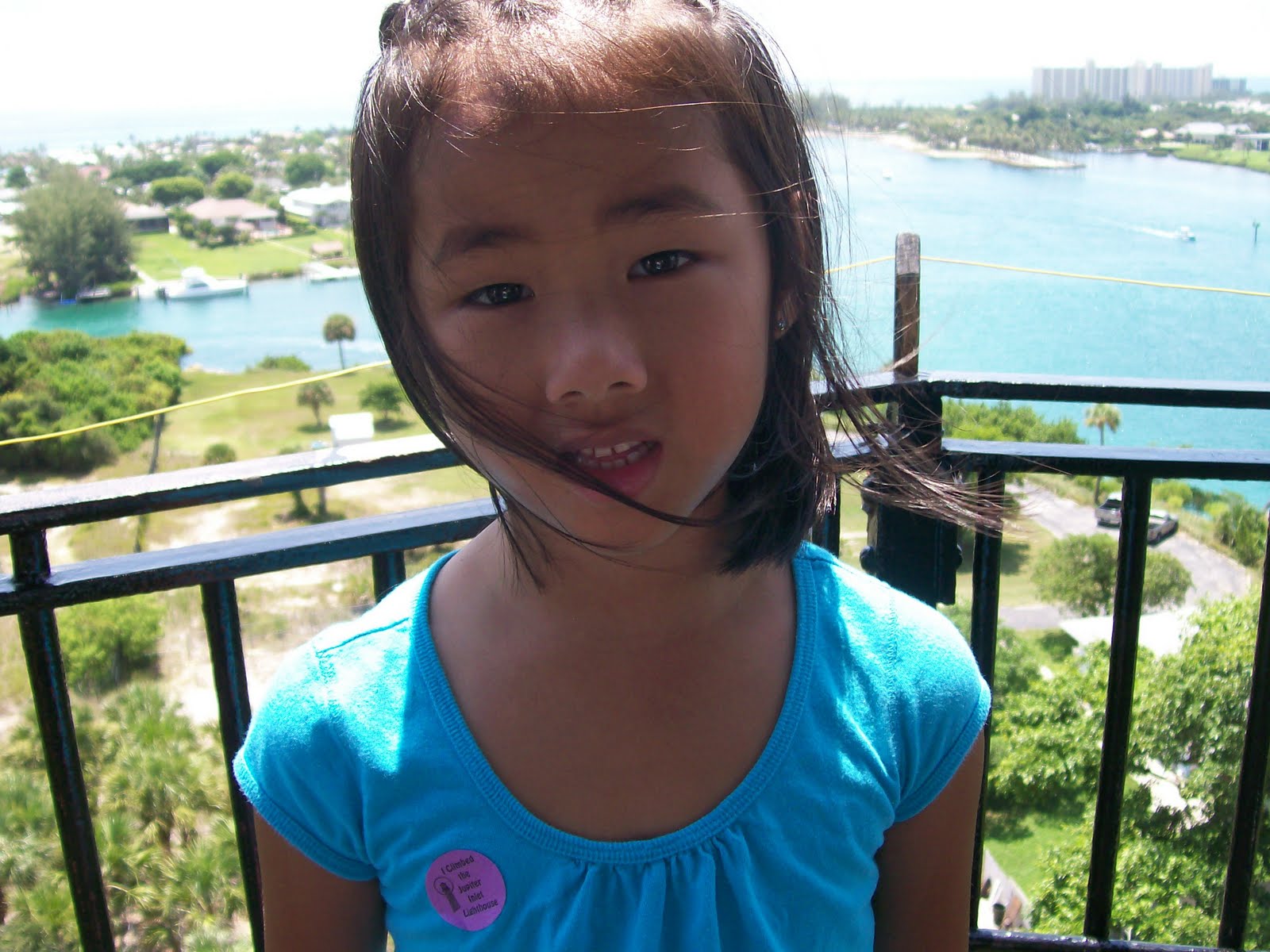
We visited the Jupiter Lighthouse today -- the kids climbed the 105 steps and have the "I Survived the Climb" certificates to prove it!  My mom and I decided to sit it out, so thank goodness for William to shepherd the girls up and then down those steps!  He's also responsible for all the great photos.

Stairs spiraling upwards inside the lighthouse.

The view from the top.

Zoe at the top.

Maya at the top.

Zoe spirals down.

The 80-year-old banyan tree, aka "walking tree" at the base of the lighthouse.

A lizard in the roof of the Indian tiki hut on the lighthouse grounds -- built there to commemorate the Seminole Indians who were forced off the land to make way for the lighthouse.

A pineapple growing in the replica garden next to the original settler's cabin, known as a "cracker house," after the whips used by the cowboys to herd cattle.

"Are They Orphans?" Redux

Last year we stayed at this same resort at the same time, and met a little girl who asked if my kids were orphans -- you can read all about our conversation here.
Well, imagine my surprise when we met the same little girl at the pool this evening!  No questions, no conversation, just a sweet meeting.  She actually recognized Zoe & Maya, we didn't recognize her (that happens all the time when you're a conspicuous family.).

The girls frolicked in the pool together, and said goodbye, since we're leaving tomorrow.  I'll take some credit for the fact that the little girl didn't have questions this year!

Just Talk

In the Texas Observer, Just Talk, by Debra Monroe, author of the memoir On the Outskirts of Normal:

In 1996, I was a white woman with no plans to marry, living in a small Hill Country town. I wanted to be a mother and started looking into adoption. I didn’t know that in 1972 the National Association of Black Social Workers called transracial adoption “cultural genocide.” In 1972, I was a schoolgirl. I’d watched the civil rights movement on TV, and it seemed like a battle black people fought with manners while white people fought with clubs and fire hoses.

If I reconsider the national mood then, I realize only a hundred years had passed since white people bought and sold black people, babies included, a hundred violent years for anyone assuming that the rights and protections promised by the Reconstruction Amendments—but revoked by Jim Crow laws—still applied. Miscegenation laws had only just been overturned in 1967. Angry suburbanites still protested desegregation. It was too soon for interracial anything, so agencies didn’t do transracial adoptions, not even after 1994, when the Metzenbaum Act was passed to address the fact that children of color were overrepresented in the child welfare system. It was amended in 1996, making the denial of placement because of race unambiguously illegal.

I made my first calls to adoption agencies that year. Staff members asked warily if I’d be open to transracial adoption. Most staff members were white. During one call, when I said yes, the receptionist snapped: “Do you know what transracial means?” Her tone gave me pause. “I think so,” I said, parsing syllables, “adoption across races.” She said, “The child will be black!” Black was a whole other category of transracial, apparently. I ended up with an agency whose values seemed like my values: Its staff members didn’t tense up discussing race. I filled out paperwork. I underwent hours of training. No one told me the law had just changed. A happy accident, I think now, in that I didn’t see I’d be countering unsolicited conversations about race—conversations unearthing curiosity, uneasiness, and idealized visions of the future—for the rest of my life.
It's very me-centered, isn't it?  Not much recognition of what her daughter will face for the rest of her life . . . .  Because it will be more than "just talk" for her.

India Court Orders Search for 35-year-old Adoption Records

From Yahoo News in India:

The registry of the Bombay High Court will have to trace the documents of an international adoption which took place 35 years ago. A division bench of Justice B.H. Marlapalle and Justice Anoop Mohta on Monday directed the high court's registry to trace the documents on the adoption of Daksha Van Dijck, who was adopted by a Dutch couple in 1975. The direction came following a petition filed by Dijck (34) seeking help to search her roots. Dijck, a clinical psychologist and who has worked as a scientist at Maastricht University, has filed the petition alleging that she was probably kidnapped as an infant in 1975 and was placed for international adoption by a Matunga-based adoption agency.

Sunday, August 1, 2010

Flying


That would be my 16-year-old nephew, William, parasailing.  His description -- "it was freaking AWESOME!"  Next, he says, he wants to try sky-diving.  I'm sure my brother will be thanking us for introducing William to extreme sports!

Saturday, July 31, 2010

A Walk on the Wild Side


Our walk on the wild side was at McCarthy's Wildlife Sanctuary -- a very cool place in Palm Beach.  They get most of their animals from government agencies that have impounded the animals as abused or neglected, or from owners with permits to possess such exotic animals.  People also bring them pets they no longer want or can handle, or animals they've found injured.  They return to the wild those they can, but many of the animals have been raised in captivity and could no longer survive in the wild.  We got to see many of those animals up close and personal!

Zoe was brave enough to pet a baby crocodile and a snake, and hold a tortoise.
William was willing to hold ANYTHING -- including a bearded dragon, a snake, and a much larger tortoise than Zoe's!


The only animal Maya was willing to touch was a baby squirrel, which she would do only while the guide held it -- no picking up any animals for Maya!  The guide told us that someone in the neighborhood had brought it by, and they were going to raise it to release into the "wild."

The squirrel wasn't the smallest things we saw -- that would have been the lizards that were EVERYWHERE (and I think William took pictures of ALL of them!).

Then there were the BIG cats, including a lion, several tigers, black leopard, a jaguar/black leopard mix, and a TINY 3-week-old Florida panther.  The tiger and the black leopard were left in a Motel 6 in Orlando, and the manager called the sanctuary to come pick them up in the dead of night before any of the motel guests knew!


It was really an amazing tour.  The group consisted of the 5 of us, and a dad and son, and that's it.  We were able to get really close to the animals, and learned the history of each and information about their lifespans in captivity.  It was a good lesson for everyone to learn, as we heard again and again about someone who got an animal when it was cute and little, and then couldn't handle it as it grew.  So many ignorant people who can't see the 170 pound panther in the cuddly panther cub.  I know there's something about adoption in that comment . . . .

Our last "wild thing" wasn't so wild -- a manatee mailbox at a house near our hotel.  I wonder what the owner thinks of all the tourists who pile out of cars to admire  "Barbara Manatee" (all you Veggie Tales fans know why the kids named her Barbara!).

Transracial adoption -- for or against?

A thoughtful post about transracial adoption at Irene's Daughters:

I am still quite torn over the issue [of transracial adoption]. Even more so since so many of the children needing homes in this country are dark skinned. Sometimes I think, “Why am I making this such a big deal? Doesn’t this really come down to making sure my child knows their self worth regardless of skin color? Surely I could teach them the proper ways of responding to racism.” Then I read a blog like yours….


To be very honest, I felt after talking to you about it that I should never consider adopting a child of color. They really would be better off in foster care or in an orphanage.

Above are a couple of comments I’ve received after posting about transracial adoption. For those who didn’t grow up with me or don’t know much about my childhood or my adoption history — which would be almost all of you, I guess — I used to feel a great deal of personal responsibility to present adoption in a positive light. I was this little self-appointed poster child for adoption, particularly transracial adoption. I always spoke of it in the most glowing terms, and minimized any possible issues arising from it (in my own life and in the lives of others). I learned this from my own parents (who always insisted they were “colorblind,” and told me that was how I should be, too), but it was as much for their benefit as for my own — I thought that people might misunderstand or, worse, pity me if they thought for a second that adoption wasn’t all sunshine and roses for all concerned.

There was a time when I would have been racked with guilt if anyone told me I had dissuaded them from considering adoption, or thinking well of it. Truthfully, it still brings me up short, because I still feel that sense of responsibility, though now it’s more from the time I’ve spent working in adoption advocacy and education. I don’t walk around with my parents on a daily basis any longer; no one knows I’m part of a transracial adoption unless I volunteer it, and so I feel less pressure to present myself as evidence in its favor. I think that’s a good thing, and much healthier for me.


* * *

Despite its flaws, and the times when it doesn’t work out “perfectly,” I am still about as pro-adoption as you can get without turning a blind eye to potential problems and abuses.

Friday, July 30, 2010

A Walk on the Beach


China Testing DNA Before Adoptions

So says Amanda Kloer at Change.org's End Human Trafficking:

The baby trafficking industry in China has been growing rapidly in the past few years, now encompassing children sent to the U.S. and Europe and trafficked internally. While some of the infants and children who are bought and sold on the black market are orphans, others are kidnapped, lured away, and even purchased from poor and desperate families. By taking babies from the poor and selling them to the rich, traffickers can make bank. But the Chinese police hope DNA can change that.

The national database China has developed contains DNA samples from over 100,000 missing, homeless, or trafficked children and over 35,000 parents. Their goal is to test all children against the database before being adopted. If the child has a relative in the database or has been reported missing at some point, the police will then have the chance to contact the child's biological family before the adoption goes through. These rules apply to foreign adoptions as well. So far, testing is only being applied to children being adopted, but may hopefully be available to all children in the future.

DNA matching has already allowed several families to reunite with their missing children. And if the policy of checking the database before every adoption is really implemented, it could be a hindrance to traffickers who kidnap children and sell them to adoption agencies. But for the strategy to be effective, China needs a quorum of parents reporting their missing children and willing and able to pay the fees associated with a DNA test. Plus, this plan only addresses child trafficking through legal adoption means — underground adoption operations could easily skirt the testing requirements.

Thursday, July 29, 2010

We're on Vacation!

It's that time of year again when I have the misfortune of presenting at a work conference in West Palm Beach.  Pity me!

And it's that time of year again when the blog turns into a travelogue.  Mostly, I'll be recording our vacation fun for the benefit of family, and you are all welcome to come along!  If something adoption crosses my path, I'll try to throw it up on the blog, but no promises!

This year my nephew, William, the handsome devil in the photo above, has joined us for vacation fun.  And we're all thrilled that Mimi was able to come along, too.  So it's true family fun this week.

Wednesday, July 28, 2010

Fate Uncertain for 12 Haitian Airlift Kids

The AP reports:

Six months after a chaotic airlift to the United States, 12 Haitian children remain in a Roman Catholic institution near Pittsburgh, their fate in limbo while U.S. and Haitian authorities struggle to determine which nation should be their future home.

Their case is complicated and politically sensitive, and all parties say they want the best outcome possible for the children. Yet impatience in some quarters is growing.

"It's astounding to me that the bureaucracy can't get this done," said Pennsylvania Gov. Ed Rendell, who took part in the airlift. "It's unfair to these children. Let's get them adopted by loving families."

Unlike some 1,100 other children flown out of Haiti to the U.S. after the Jan. 12 earthquake, the youths at the Holy Family Institute in Emsworth, Pa., were not part of the adoption process prior to the quake and — according to some legal experts — shouldn't have been eligible for the emergency program.

There are American families eager to adopt them now, including some who've been screened and approved by adoption agencies. But there's been little in the way of public updates on the case as federal agencies, the Haitian government and the International Red Cross try to determine whether the 12 should be put up for U.S. adoption or returned to relatives in Haiti.
And with impressive understatement, the article says, "In hindsight, it's clear that including the 12 children in the airlift has created a long-running dilemma."

DADT Doesn't Work For Adoptive Parenting

Dawn Davenport at Creating a Family blog has a great post, "'Don't Ask, Don't Tell' Doesn't Work for Adoptive Parenting, Either" [LOVE the title!] about the importance of talking adoption with our kids -- not just as toddlers, but as they grow older, too:

We know, however, from talking with teens and adult adoptees, that kids don’t stop thinking about being adopted when they outgrow their footy pajamas. In particular, they wonder about their birth parents: who they are, what they liked to do, what they looked like, why they didn’t parent them. Some kids think about this a lot, some think about it a little, but from what I can tell from talking to teens and adults, most think about it some.

There are some kids who will readily talk and ask these questions to their parents and birth parents, if they are in an open adoption. But lots of kids, my own included, might think and wonder, but never bring the subject up. And even the most curious and talkative child will steer clear of this conversation if they sense that it makes their parents uncomfortable. It is way too easy for parents to assume that if it isn’t spoken, it isn’t thought. If the kids don’t ask, then we don’t need to tell. This is mighty convenient since we just as soon not talk about it anyway. If we’re not careful, this can become a self perpetuating cycle. Our discomfort, keeps them silent, and their silence justifies our own.

So what’s a parent to do?
Go find out what savvy adoptive parent Dawn does.