As an adoptee who has returned to his birthplace of Lebanon, I have been actively watching the rise of this trope [Islamophobia and adoption] in the media, on online forums, as well as in private online exchanges for the past seven years. In 2009, for example, the AP reported on a couple trying to adopt from Egypt. Compared to the crime of this couple and the corruption of government officials there, it is nonetheless Islam that bears the burden of opprobrium in the article: Adoption in Egypt is defined as being “snarled in religious tradition”. This became a contentious discussion on the web site Canada Adopts, where the given of the argument was basically how to get around these Islamic invocations, as if they somehow were to blame for the legal transgressions of the would-be adopters, painted as virtuous Samaritans.Be sure to read the whole thing; I was particularly struck by the parallels the author draws between interpretations of the Bible by the Christian Adoption Movement as justifying adoption ("God adopted us!") and interpretations of Islam that seek to do the same thing ("Muhammad was adopted!"). His exigesis of the Qur'an as (no) textual support for adoption reminds me of David Smolin's dismantling of the Biblical/theological basis for the Christian Adoption Movement. Both of which makes me think of what Inigo Montoya of the Princess Bride might say about these uses of the word adoption: "You keep using that word. I do not think it means what you think it means."
For another example, we need go to Pamela Geller’s web site Atlas Shrugged. Here the tables are turned on would-be adoptive parents of Moroccan children who would be required to maintain the child’s Muslim faith. Ms. Geller describes this as some evil Islamic fifth column in the making, despite the fact that most every orphanage on the planet is Christian-based and missionary in outlook and likewise requires that the parents be of a particular faith in order to adopt.
Similarly, in her article for The Daily Beast, Asra Nomani writes an article which implies that the orphaned children of Pakistan are being recruited by Al-Qaeda as future suicide bombers. Her answer to this problem? To undo the “antiquated, shortsighted, and regressive stricture that makes adoption illegal [within Islam].” This focus on Islam as a problem for adoptive parents who supposedly want to help the orphans of the world is quite loaded, and needs to be deconstructed on two levels, first in terms of the historical and economic/political function of adoption, and second in terms of linguistic and theologic use/misuse of the term.
Wednesday, April 18, 2012
Adoption & Islam
An interesting and provocative piece by Daniel Ibn Zayd in Dissident Voices, responding to this piece in the Daily Beast about Islam and adoption, which I posted about here:


Tuesday, April 17, 2012
California Court Won't Undo Ukrainian Adoption
Interesting case, reported by California's Children blog, where adoptive parents seek to disrupt an international adoption:
And the California statute isn't all that unusual. I've mentioned before (see here and here) that certain "reforms" were put into place in the late 80s/early 90s as a response to "wrongful adoption" lawsuits, where adoptive parents sued states and adoption agencies alleging that they were affirmatively lied to or information was hidden so that they didn't know about problems the kids had. Among the reforms were increased informational requirements prior to adoption, and these kind of statutes that make vacating the adoption the remedy for wrongful adoption.
Because of its jurisdictional ruling, the court doesn't have to address the merits of the petition here, deciding whether the child is "unadoptable" because of a "developmental disability or mental illness" of which the adoptive parents "had no knowledge or notice." Reaching the merits might have led to the same results, since there was some evidence that the adoptive parents were aware of some of the issues prior to the adoption:
So you parent. Even when it's expensive, even when the child doesn't meet your expectations, even when it's damned difficult. You parent. And if the best thing for your child is intensive foster care placement in Arizona, that's what you do. And you're still the parent. Because no one ever said it would be easy.
"This is a tragic case in which there can be no good ending for anyone."The decision rests on a California statute, section 9100 of the California Family Code, that does, in fact, allow a court to vacate an adoption:
Thus begins the decision (written by Justice Rick Sims, and concurred by Presiding Justice Arthur Scotland and Justice Harry Hull) of the State Court of Appeals, Third District, in the matter of Eleanor Pracht-Smith et al., v. the California Department of Social Services.
* * *
The adoptive parents found that the child could not live in a "normal home environment, is unadoptable..." and the child has been in "intensive foster care placement" in Arizona for four years. In 2008, the parents filed in Yolo County Superior Court to set aside the adoption. Yolo said -- in layman's language -- that it didn't have jurisdiction, the Ukrainian court that issued the adoption decree was the venue.
The issue is, of course, lifetime support of this child. In upholding the Yolo decision, the court of appeals has determined that the support be the responsibility of Martin Smith and Eleanor Pracht-Smith.
If a child adopted pursuant to the law of this state shows evidence of a developmental disability or mental illness as a result of conditions existing before the adoption to an extent that the child cannot be relinquished to an adoption agency on the grounds that the child is considered unadoptable, and of which conditions the adoptive parents or parent had no knowledge or notice before the entry of the order of adoption, a petition setting forth those facts may be filed by the adoptive parents or parent with the court that granted the adoption petition. If these facts are proved to the satisfaction of the court, it may make an order setting aside the order of adoption.So much for "adoption is forever," hmm? The court here isn't refusing to vacate the adoption because it feels the parents shouldn't disrupt, it's simply that the law applies, the court says, only to a child "adopted pursuant to the law of this state." So feel free to disrupt your California adoption, but not this Ukrainian one.
And the California statute isn't all that unusual. I've mentioned before (see here and here) that certain "reforms" were put into place in the late 80s/early 90s as a response to "wrongful adoption" lawsuits, where adoptive parents sued states and adoption agencies alleging that they were affirmatively lied to or information was hidden so that they didn't know about problems the kids had. Among the reforms were increased informational requirements prior to adoption, and these kind of statutes that make vacating the adoption the remedy for wrongful adoption.
Because of its jurisdictional ruling, the court doesn't have to address the merits of the petition here, deciding whether the child is "unadoptable" because of a "developmental disability or mental illness" of which the adoptive parents "had no knowledge or notice." Reaching the merits might have led to the same results, since there was some evidence that the adoptive parents were aware of some of the issues prior to the adoption:
In late 2003, appellants spent several weeks in Ukraine for the adoption. On December 15, 2003, by decree of a Ukrainian court, appellants adopted M.S., a three-year-old Ukrainian girl. The Ukrainian court decree stated in part: "It was found out from the case documents that the child's [biological] mother is mentally sick. She left the child at the hospital and never visited her. The place of father's residence was not identified. Since February 2002 the child has been made the ward of the government. The medical history of the girl says that she is almost healthy though psychologically delayed." A hospital record says the mother has epilepsy.The parents allege, though, that they didn't know any of that until after the adoption. And in fact, they discovered after returning home, that "almost healthy though psychologically delayed" may have been an understatement:
In California, various evaluations were performed due to M.S.'s low level of functioning. Health care professionals diagnosed her with spastic cerebral palsy, reactive attachment disorder, oppositional defiance disorder, moderate mental retardation, global developmental delay, ataxia, fetal alcohol syndrome or effect, microcephaly, and posttraumatic stress disorder. Appellants assert M.S. cannot live in a normal home environment, is unadoptable, and has been living in intensive foster care placement in Arizona since 2005.So what's an adoptive parent to do?! You can't put 'em on a plane back to Russia, you can't get the court to relieve you of the responsibility. . . .
So you parent. Even when it's expensive, even when the child doesn't meet your expectations, even when it's damned difficult. You parent. And if the best thing for your child is intensive foster care placement in Arizona, that's what you do. And you're still the parent. Because no one ever said it would be easy.
Monday, April 16, 2012
Stranger Adoption and "Chimpanzee"
Yesterday, I posted about adoption themes in the new DisneyNature film, Chimpanzee. Imagine my surprise when the guest on The Daily Show tonight was Dr. Jane Goodall, spokesperson for the film!
The review I posted had this line: "even in nature foster care and adoption happen." Hmm. So I was intrigued when Dr. Goodall spoke about how the orphaned chimpanzee, Oscar, was taken in by the leader of the pack, Freddie. Jon Stewart asked her if this was a common thing (I got the feeling he was asking if it was a common thing for a MALE to take in the orphan, but maybe that was just me), and Dr. Goodall said no. Ordinarily, she said, when a mother dies, the orphaned chimp would be cared for by an older brother or older sister (that takes care of the gender thing). She said that it was extremely unusual for someone outside the family to take in the orphan.
So, while adoption happens "even in nature," it's relative adoption, not stranger adoption among chimpanzees. Who knew?!
The review I posted had this line: "even in nature foster care and adoption happen." Hmm. So I was intrigued when Dr. Goodall spoke about how the orphaned chimpanzee, Oscar, was taken in by the leader of the pack, Freddie. Jon Stewart asked her if this was a common thing (I got the feeling he was asking if it was a common thing for a MALE to take in the orphan, but maybe that was just me), and Dr. Goodall said no. Ordinarily, she said, when a mother dies, the orphaned chimp would be cared for by an older brother or older sister (that takes care of the gender thing). She said that it was extremely unusual for someone outside the family to take in the orphan.
So, while adoption happens "even in nature," it's relative adoption, not stranger adoption among chimpanzees. Who knew?!
Colombia: Government Accused of 'Kidnapping' Children for International Adoption
So says Colombia Reports:
In terms of raw numbers, there are not that many adoptions from Colombia to the U.S. -- 216 in 2011, 235 in 2010. But when compared to the rest of South & Central America? Colombia is the only country with adoption to the U.S. in the hundreds. Last year, there were 32 adoptions from Guatemala, 30 from Nicaragua, 22 from Mexico, 13 from Peru, and 11 from Honduras. No one else is even in double digits. And Colombia is in the HUNDREDS.
Certainly seems suggestive. . . .
Colombia's Family Welfare Institute "kidnaps" Colombian children by giving them up for adoption to foreign families against the will of their biological parents, several reports said.So is there something corrupt happening in international adoption from Colombia? Sometimes we look at statistics to figure that out. Is there a sudden spike in numbers, for instance? Nope, not recently at least. According to the State Department statistics, here are the adoptions from Colombia to the U.S. since 1999:
In a program aired Sunday, television station Caracol told the story of a young boy named Steven who was born in Colombia but adopted by a Dutch family.
Steven's biological parents said he was taken from them against their will by the ICBF. The agency said Steven's original parents were unfit to care for him and that the state put the child up for adoption for his own safety. Colombia is one of the few countries where children can be placed with foreign families without the consent of their biological parents.
This is not the first time the ICBF has been accused of unjustifiably taking children from parents and sending them abroad. Colombian channel RCN TV and Colombian newspaper El Tiempo have run similar stories in the past.
So adoptions from Colombia seem to be on the same decline that the rest of international adoption is experiencing, no suspicious spike since one in 2002 and one in 2006. So is there anything else in the statistics that are enlightening?
2011 216 2010 235 2009 238 2008 306 2007 309 2006 344 2005 287 2004 285 2003 272 2002 335 2001 265 2000 245 1999 231
In terms of raw numbers, there are not that many adoptions from Colombia to the U.S. -- 216 in 2011, 235 in 2010. But when compared to the rest of South & Central America? Colombia is the only country with adoption to the U.S. in the hundreds. Last year, there were 32 adoptions from Guatemala, 30 from Nicaragua, 22 from Mexico, 13 from Peru, and 11 from Honduras. No one else is even in double digits. And Colombia is in the HUNDREDS.
Certainly seems suggestive. . . .
Transracial Adoption Challenges Parents, Kids
In the Toledo Blade, a story about Kevin Hofmann, transracial adoptee:
On the subject of race, it's not politically correct when white people say, "I don't see color," said Kevin Hofmann, of South Toledo. "In the black community, that can be offensive. I am proud to be a person of color."
The author of Growing Up Black in White (Vine Appointment Publishing Company, 174 pages, $14.95), Mr. Hofmann talks candidly about his experience as a biracial man. Born in Detroit in 1967 less than three weeks after the riots, he was 3 months old when he was adopted by a white couple. He describes his parents, the Rev. Richard and Judy Hofmann, as progressive on matters of race.
* * *
Mr. Hofmann discusses transracial adoption in a yet-to-be broadcast edition of ABC Nightline: Late Evening News program. True, these children adopted into wealthy celebrity homes won't have to cope with financial disadvantages, but more is involved than just giving them a good home and family.
"You cannot just love a child, but you have to understand that he belongs to a certain culture," Reverend Hofmann said about transracial adoption.
The assumption that it is politically correct to be "color blind" does not benefit the children, the younger Mr. Hofmann said.
"My answer to that is, 'If you are color blind, how do you see your child?' " asked Mr. Hofmann, who posts blogs on the issue on www.kevinhofmann.com. "When your kids walk out the door, they will be impacted about what people see. You have to prepare your children before they go out."
Sunday, April 15, 2012
Adoption Themes in "Chimpanzee"
Here's a review of the upcoming DisneyNature movie, Chimpanzee, from a mom who saw a preview, highlighting adoption themes in the movie:
I didn't expect the adoption theme that caught me off guard. Now adoption themes in family movies often go one of two ways - very poorly rendered as a joke within the movie - like ELF - or poor orphan child victim of the foster care system that is always headed up by an evil foster parent, never caring, always in it for money. Occasionally you can substitute adoptive parent for the angry evil foster care parent. Poor sad waif. Victim mentality that drives me bonkers. Or, in nature usually cartoon characters that are adopted by some species outside their normal experience. Cat taken in by raccoons etc.Just an FYI for anyone planning to see it!
I am here to say that is not the case with Chimpanzee. This is the story of Oscar, baby chimp born to a caring Mom and a big extended family in the jungles of Africa. This is a stirring look at how one unexpected member takes over when there is a need and how, even in nature foster care and adoption happen. It's beautiful and funny and charming and amazing and I know we will see this magnificent movie again. It gets my highest rating of $$$$$.
Friday, April 13, 2012
Rejected By Mother, Artyom Happy in Russia
A report from a rare meeting between Artyom and the press:
Two years after Artem Saveliev’s American adoptive mother put him alone on a plane back to his homeland, the towheaded 9-year-old shivers and barks “No!” when asked if he ever would go back to the United States.
The boy who instantly became a potent symbol of failed adoption policies now lives in a cheery home in a village of foster families near Moscow. As he tries to move forward in his life, the legacies of his case reverberate deeply through U.S.-Russian relations.
* * *
Officials have generally refused journalists’ attempts to visit Artem, saying the attention would likely distress him and hinder his adjustment to his new life in Russia. But on Thursday, Pavel Astakhov, Russia’s children’s ombudsman, arranged a rare visit by journalists to Artem’s village, partly to draw attention to two looming court cases involving Torry Hansen, the American woman who adopted and then ditched the boy.
Artem was shy and taciturn, revealing little more of his life than that he finds “Russian spelling” to be the hardest part of school.
His Russian foster mother, meanwhile, says Artem needed months of counseling and speech therapy after his return.
His new caregiver, Vera Yegorova, says any memories of Artem’s life in Tennessee remain a “taboo” for him. She said it took months of sessions with a psychologist and a speech therapist for the boy to start communicating again.
“He is no different now from other children,” said Yegorova, a plump, vivacious 53-year-old who has raised 17 foster children at the village run by the international charity SOS.
The village consists of about a dozen houses on the edge of a forest. Five other children live in the same house with Artem and all go to a nearby school.
But for all the superficial normalcy of his new life, Artem also appears troubled. He can say “thank you” in strongly accented English, but otherwise resists speaking in English. He gets poor grades in school, has trouble communicating and speaks in short sentences.
Circle the Wagons

After serious consideration, we have decided to cancel our Adoption Blogs by Moms – 2012 contest. Our Top 25 program is meant to celebrate, connect, and support mom bloggers. Following some feedback from participants in our 2011 contest, we decided to make this year's Top 25 more inclusive. In doing so, we unknowingly stepped into a very sensitive issue and debate, and we apologize to all the moms who have been offended, no matter what your position on adoption is.What the heck are they talking about, I hear you cry?! Well, maybe you read my post about Circle of Moms removing Cassi's blog, Adoption Truth, from the contest because they didn't find her sufficiently "positive" and "supportive" of adoption. I wasn't the only one who was offended by that action (see here and here and here and here and here and here, well, you get the idea!). So, it was all of us "anti-adoption" folks complaining about that action by Circle of Moms that led to cancellation of the contest?
Not exactly! It was more like some of the other adoption bloggers yelling, "The invaders are coming, the invaders are coming," and insisting that Circle of Moms circle the wagons to keep out anyone they disagreed with.
Apparently, the activist blogs which were rising in the rankings were “a few bad apples [that] ruin the batch.” The only reality allowed in an adoption blog contest is "the reality that adoption is a loving response to a tragic reality" which "we as an adoption community [should] come together and truly embrace." Yes, those are all actual quotes from disgruntled bloggers bemoaning that adoptee and birth mother blogs ruined the contest! Oh, and you have got to see the screen grab from one of the contestant's public facebook page that Linda has at Real Daughter! "I am happy to report some of the more offensive anti-adoption blogs have been removed from this list." AND "I really don't want to see any of these negative on adoption blogs at the top of the list . . . so pisses me off."
So, the contest ended. Yet another incident illustrating the enforced orthodoxy of adoption talk. Only positive, glorifying, happy talk is allowed. Too bad that that party line does such a disservice to others who may feel differently about adoption. I'll say it again: "when adoptive parents ignore the hard truth that their experience of adoption is not the same experience as their adopted children and their birth families, when they ignore the hard truths about corruption and trafficking, they are doing damage not just to their children, but to the institution of adoption as well."
Yes, this is all just a silly little blog contest designed to draw traffic to Circle of Moms. But it cast light on this ridiculous orthodoxy where nothing negative can be said about adoption without consequences. You get kicked out of the circle, you get called a "bad apple." You're chastised for not recognizing that there can be only ONE reality about adoption, and it certainly isn't the one you're talking about. You PISS OFF those who disagree with you. And when you start drawing attention, the forum for your viewpoint has to be shut down -- for fear you might actually cause folks to see adoption as the complex, multi-layered, fraught-with-problems institution is actually is.
Circle the wagons, keep out any dissenting viewpoint!
Again, thanks to all for your votes! Too bad the contest wasn't as worthy as you all are!
Thursday, April 12, 2012
Guatemalan President Willing to Speed Up Pipeline Adoptions
From Politico, which highlights Sen. Mary Landrieu's role:
Guatemala’s president says he’s willing to speed up 350 adoptions by U.S. couples that were in process before his Central American nation suspended adoptions by foreigners in 2007 following allegations of fraud and baby theft.
President Otto Perez Molina said Wednesday he hopes to resolve those cases after meeting with Sen. Mary Landrieu. The Louisiana Democrat has been traveling to Guatemala to push for the adoptions to go through.
The Catholic League Stigmatizes Adoption
The Catholic League tweeted about the Hilary Rosen/Ann Romney contretemps (not something I'm getting into!), by attacking Hilary Rosen for adopting -- oh, and for being a lesbian, too, though why that's relevant is beyond me. Here's the tweet:


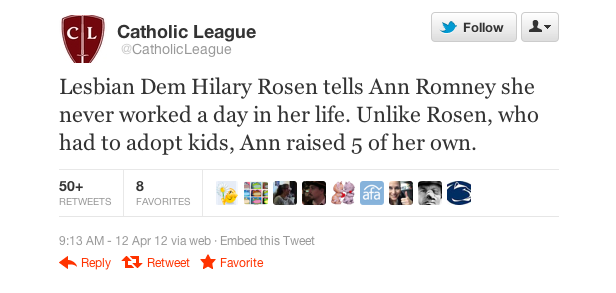
She HAD to adopt?! Let's put aside biology for a moment -- even lesbian women can give birth!!! -- how's this for showing the Catholic League's attitude toward adoption?! I posted yesterday about someone surprised to discover there was still stigma associated with adoption. Obviously, that person doesn't spend much time on social media! This tweet certainly shows that adoption stigma is alive and well.
Oh, and then the always popular adoption =/= "your OWN" child. I admit, I don't like the "my OWN" child thing because is sounds so . . . OWNERSHIP. And I don't really like the exclusivity many apply to the term, as in "she's MY own child, not her birth mother's OWN child" thing. But still. When you're using it to mean I'm less of a parent than someone who gave birth to children, I object. I won't accept that my girls' birth mothers are "less than," nor will I accept that I am "less than."
And I sure won't accept it from MY OWN Church. I've responded to the Catholic League, as have many others. Their response addresses the lesbian comment in an oh-so-mature way:

No response to the adoption comment. I suppose they think we should get over it, too, and grow up. I'd sure like it if my kids could grow up without idiots like the Catholic League stigmatizing adoption.
And if you're on twitter, why don't you let @CatholicLeague know what you think of their view of adoption as a last resort, second-best option?!
Torry Hansen Sues in Russian Court
Lovely. Torry Hansen, who returned her seven-year-old adopted son Artyom to Russia, alone on a plane, is now suing the Russian children's ombudsman:
If the lawsuit is really about being called Artyom's adoptive mother, rather than his former adoptive mother, I'm sorry to tell her that, at least under American law of libel, truth is a defense. She is still Artyom's adoptive mother, at least in the U.S., since her parental rights have not been terminated here. One cannot terminate parental rights by simply sending a child away. The fact that a Tennessee court has ordered her to pay child support is evidence that she is still his parent, since child support is only a parental responsibility.
Russian children's rights ombudsman Pavel Astakhov said on Thursday a lawsuit had been filed against him by an American woman who sent her adopted son back to Russia.This AP story adds there's a hearing next month: "Pavel Astakhov said Thursday he would like Hansen, who has sued him in a Moscow court, to testify at a hearing scheduled for next month."
Torry Hansen filed a lawsuit in Moscow’s Savelovsky Court, seeking retraction of a November 24, 2011 article in the Rossiiskaya Gazeta government daily. She also demands punitive damages.
"The essence of the lawsuit is that I call Hansen an adoptive mother, while she wants me to call her Artyom Savelyev’s former adoptive mother,” Astakhov said.
"I’m glad a lawsuit was filed by Torry Hansen against me and the Rossiiskaya Gazeta. I’ll gladly meet her and request that she visits Russia and the court,” he added.
Hansen was living in Tennessee in April 2010 when she put Artyom Savelyev, then 7, on a flight back to his native Russia unaccompanied, with a note saying she did not want him because he was "psychotic."
Astakhov said that the Russian side would seek child support payments from the U.S. woman, according to the March 8 U.S. court ruling.
“We will try to make her pay the cost of Artyom’s support, nothing more,” he said.
According to the child ombudsman’s estimates, the boy’s stay in a group home costs 42,000 rubles per month (over $1,400), not including psychological treatment costing 27,000 rubles (over $900) per month.
If the lawsuit is really about being called Artyom's adoptive mother, rather than his former adoptive mother, I'm sorry to tell her that, at least under American law of libel, truth is a defense. She is still Artyom's adoptive mother, at least in the U.S., since her parental rights have not been terminated here. One cannot terminate parental rights by simply sending a child away. The fact that a Tennessee court has ordered her to pay child support is evidence that she is still his parent, since child support is only a parental responsibility.
Wednesday, April 11, 2012
Adoption Stigma Still Exists
The reviewer of a (relatively) new anthology, Somebody’s Child: Stories About Adoption, was surprised to learn that there is still stigma associated with adoption:
Before I started reading Somebody’s Child: Stories About Adoption, edited by Bruce Gillespie and Lynne Van Luven (Touchwood Editions, $19.95), I worried about how well I would be able to relate to the stories in the collection. After all, I hadn’t had any firsthand experience with adoption.Has anyone read this book? What do you think of it?
I need not have been concerned. While the stories in the anthology focus on adoption and the quest for answers about identity and connectedness, they tap into universal themes: how family can disappoint as well as delight us, and how ultimately each individual is left to make sense of the story of his or her own life.
Somebody’s Child — like the two earlier titles in the same series Nobody’s Mother: Life Without Kids and Nobody’s Father: Life Without Kids — are designed to promote “a broader understanding of what North American families look like these days — something that is important for all of us,” says Gillespie, an assistant professor of journalism at Wilfred Laurier’s Brantford Campus, who co-edited the collection with Van Luven, associate dean of fine arts at the University of Victoria. “There is real value in people just sharing their stories, happy endings or not.”
What surprised me most, as I became more and more wrapped up in the stories (so wrapped up, in fact, that I came dangerously close to missing my train stop) was the extent to which adoptees continue to feel stigmatized. I had no idea — and that makes me feel sad and guilty for not knowing.
Korea: Single Moms Day
In Korea, there is still significant stigma associated with being a single mother, the same stigma that's been a boon for international adoption from Korea. Trying to destigmatize single motherhood, Korean adoptee and single mother organizations in Korea have designated May 11 "Single Moms Day." Here's a report from last year -- the first Single Moms Day in Korea:
May 11 is the first “Single Mom’s Day,” created by adoption and single mother groups. Noh plans to tell her story at an international conference that day at the Community Chest Auditorium hosted by Truth and Reconciliation for the Adoption Community of Korea (TRACK) and KoRoot, a guest house for overseas adoptees returning to South Korea.Thanks to a link at Land of a Gazillion Adoptees' facebook page, here's where you can get more information and help out with a fundraiser for the second annual Single Moms' Day: TRACK's Fundraiser for Single Moms' Day.
“Society will only change if mothers like me show themselves more. I am a mother whose child was sent for overseas adoption, and a single mother. If a base is created so that single mothers can also raise their children, the nation’s concerns about adoption will also disappear,” said Noh. “We must lessen the pain that must be suffered to the day they die by those affected by overseas adoption.”
Kwon Hee-jong, a coordinator at the Korean Unwed Mothers Support Network (KUMSN), said, “70 percent of the mothers at state-supported facilities relinquish their children for adoption, while in the United States, the ratio of mothers who give up their children is just 1 percent.”
Kwon added, “It is absolutely necessary that we eliminate prejudices so that birthmothers can raise their children on their own and expand support before encouraging adoption.”
"International adoption is not always in the best interest of every orphaned child"
An American adoptive family, living and working at an orphanage in Ethiopia, offers a cautionary take on international adoption:
For the sake of full disclosure, let it be said that we are an adoptive family. Just over two years ago, we adopted a beautiful 3 ½ year-old girl from Ethiopia. She’d been in an orphanage since just a couple of months after birth. We met her while visiting an orphanage run by the Missionaries of Charity (the order started by Mother Theresa of Calcutta) in Addis Ababa. We love our daughter dearly and are so glad to have her as a part of our family. We have no regrets about adopting her whatsoever. Despite the high-quality, loving care provided by the Mother Theresa sisters and the staff, we firmly believe that she’s been able to thrive and grow as a part of our family in a way that she would never have been able to if she’d continued to grow up in institutional care. Having said all that, through our own adoption process, our connections in the adoptive community, and our experience living and working at an orphanage here in Ethiopia, we’ve become very cautious and critical proponents of international option. We’re still proponents, but we’ve come to recognize that international adoption is not always in the best interest of every orphaned child. Before pulling a child from family, community, culture, language and country, one has to think hard about the best interest and specific situation of that child. We have also come to recognize that, while international adoption may improve the life of a specific child, it is not a social solution for the larger issue of orphaned children in Ethiopia.Please read the whole thing; though Ethiopia-specific, the blog raises important points relevant to all international adoption.
* * *
International adoption is a very complicated issue. I don’t know about other countries, so I can only really speak to Ethiopia. In the past 10 years, international adoption form Ethiopia has become quite popular and “sexy” (Angelina Jolie, etc.). In the case of infants, there is actually more “demand” than “supply.” Those are terribly crude terms, but they explain the situation. There are actually more adoptive parents in North America and Europe waiting for Ethiopian infants than there are orphaned infants in Ethiopia; thus the long waiting lists. This strikes me as concerning. There is actually a situation of parents waiting for children to be born and orphaned. These adoptive parents are in the process not to adopt an orphan, but to adopt a potential future orphan.
Tuesday, April 10, 2012
The Circle is Broken

Circle of Moms. A website for moms, with the tag line, motherhood, shared and simplified.
What a great concept -- an unbroken circle of women who have the common experience of being mothers, something that connects us when nothing else does. Solidarity. Connection. Infinity without end. But Circle of Moms broke that circle when they sent the following email to Cassi of Adoption Truth, just as she reached the number 2 spot in the Top 25 Adoption Blogs by Moms contest:
--“Dear Cassi,That's it, and her blog, voted for by over 100 people, disappears from the list. Cassi is kicked out of the circle.
I’m writing to let you know that we have unfortunately had to remove your blog from the Top 25 Adoption Blogs by Moms competition. As described on the contest page, the Top 25 Adoption Blogs by Moms contest is open to “mom bloggers who write about adoption or foster parenting in a supportive, positive way”.
Best,
The Circle of Moms team” --
Why? She is a mom. She is a blogger. She writes about adoption. So why is she kicked out of the circle? Apparantly, the powers that be at Circle of Moms doesn't like what she has to say at her blog or the way that she says it. She doesn't belong in the circle because she is not sufficiently "supportive" or "positive" about adoption. This is censorship in its starkest form. Her speech is suppressed because others disagree with it. How cowardly is that?! Circle of Moms is enforcing the norm that the only privileged speech about adoption is speech that sticks to the happy-happy-joy-joy narrative. That is especially so when the speaker is a first mother or an adoptee.
Which brings me to the second answer to the WHY? question. Cassi is being censored because of WHO SHE IS as much as for what she says. Cassi relinquished her child for adoption. She writes about coercion in adoption consent. So do I. She writes about adoption reform. So do I. She writes about open records. So do I. She writes about how adoption has affected her now-adult child. I also write about how adoption has affected my not-yet-adult children. SO why is Cassi censored, and I am not (or at least not yet!)? Because adoptive parent speech is the only privileged speech in the adoption triad. Because I sometimes post photos of my cute adopted kids. And isn't that a shame, that my status privileges my speech, while Cassi's status enforces silence?
When I first learned that Cassi was kicked out of the circle, my immediate reaction was to withdraw from the clearly-rigged contest. I'm keeping myself from doing so by reminding myself that the only cure for bad speech -- or enforced silence -- is MORE speech. Or as Justice Louis Brandies said so eloquently, "If there be time to expose through discussion the falsehood and fallacies, to avert the evil by the process of education, the remedy to be applied is more speech, not enforced silence."
Adoption is complicated. It is not a simple either/or, for-or-against, pro- or anti-adoption duality. It is complicated, multi-faceted, fraught with ambiguities. One person's gain is another person's loss. One person can both gain and lose in adoption. This complicated institution of adoption needs MORE speech, not less. Only by discussion ALL perspectives can we explore the multi-layered truth that is adoption.
Here's what I said before when I was accused of being "anti-adoption," the short-hand equivalent of not writing about adoption in "a supportive, positive way:"
Yes, I've adopted and it has brought me immeasurable joy. And it has brought my children loss, pain and grief, as well as joy. It has brought their birth families loss, pain and grief. And when corruption and child trafficking enter the picture, adoption brings everyone involved even more loss, pain and grief. The only joy then is in the black hearts of corrupt officials and child traffickers.So I'm sticking with the contest, and I'm taking Cassi's issues with me, even though I cannot match her eloquence, her passion, her lived experience. Cassi has asked people to keep voting in the contest, and to vote for the following blogs:
And when adoptive parents ignore the hard truth that their experience of adoption is not the same experience as their adopted children and their birth families, when they ignore the hard truths about corruption and trafficking, they are doing damage not just to their children, but to the institution of adoption as well.
Frankly, it's going to be the over-reaching of the "pro-adoption" folks that bring an end to international adoption, not anything the so-called "anti-adoption" folks do. Haven't you noticed the pattern? A country opens to international adoption. . . just a trickle at first. Then it's push, push, push for more, more, more adoptions from that country. Now the trickle is a flood of money as more and more and more adoptive parents flock to the country. And the money brings corruption. . . . And the country shuts down to international adoption. . . . Wash. Rinse. Repeat. "Pro-adoption?" Really workin' out for you, huh?
The Declassified AdopteeI really appreciate Cassi's positive support for my blog, as well as these other fine adoption blogs. So please vote -- before these blogs are also censored from the list! Let's repair the circle.
Musings Of The Lame
Adoption Talk
Neither Here Nor There
iAdoptee
To Tell The Truth – Please Stand Up
Monday, April 9, 2012
Abandoned
An adoptive mother charged with abandonment for returning her adopted child to Delaware Family Services:
One day in August 2007, Cleo Klepzig picked up her 10-year-old adopted son from the home of a respite care provider near Helena, Mont., and drove him to the airport, where they both boarded a flight to the East Coast.Remember the international version, when Torry Hansen put Artyom on a plane to Russia with a note, saying she no longer wished to parent him? I posted about the failings in Tennessee law that prevented criminal charges for abandonment. Seems Delaware law doesn't share those failings. . . .
She told the boy’s caregivers that she was taking him to visit his biological sisters in Delaware, the state from which he’d been adopted several years before.
But that’s not what she did.
Instead, she took him to the Delaware Family Services Division office in Wilmington. She found a state employee, gave her a stack of papers documenting the boy’s situation and said, “I’m leaving him with you.”
Then she walked away. She got on another plane, flew back to Montana, and went on with her life.
* * *
Klepzig has a new home in Oregon and a new job as the head of a public agency in Albany.
And the state of Delaware has a warrant out for her arrest on a child abandonment charge.
Klepzig, interviewed last week by the Gazette-Times after the warrant came to light, claims the boy was abusing a younger sibling and that she returned him to Delaware authorities only after exhausting all possible avenues to get help.
“This isn’t about just what I did,” she told the newspaper. “This is about a really broken system.”
But law enforcement authorities in Delaware and Montana say there’s simply no excuse for abandoning a child.
Sunday, April 8, 2012
Happy Easter!


Saturday, April 7, 2012
A Texas Tradition

What can you do? It's a Texas tradition! Each year, you are REQUIRED, as incident to Texas State citizenship, to photograph your children in fields of bluebonnets. We were just about to lose our citizenship status because it's been a few years, so we observed the tradition today! The fields of blue near Ennis, TX were pretty incredible -- these photos don't really do it justice.


Kate & Prince William Open to Adoption?
From Gather:
Kate Middleton and Prince William are rumored to be open to adopting a child sometime in the future, but the Queen has other ideas. One of the most important duties for the Royal couple is ensuring there is a legitimate heir to the throne. Only a child born to Kate and Will is eligible for the ascent to the throne.Well, wouldn't that be a special mixed-bio-and-adopted family? Where the adopted child is the only one NOT eligible for the throne?
A source has come forward and spoken with OK! Magazine and dished on the royal family's most intimate details. According to this unnamed insider, "Their priority is to have heirs of their own to ascend to the throne, but afterward, they feel they feel there is nothing to stop them from doing such a beautiful and humane thing as adopting a child."
* * *
Prince Charles is open to adoption, but it is ultimately Queen Elizabeth, who will have the final say. According to the insider, the Queen has no qualms about the Duke and Duchess adopting, but "only after they have at least two heirs to the throne!"
Friday, April 6, 2012
Easter Egg-stravaganza!


Zoe:

And our shy little friend J:

The highlight for Zoe was not the beautiful eggs -- it was the opportunity to hold J's baby sister, six-weeks-old gorgeous baby G (is that one brave mother, or what?!):

Just look at Zoe's face! She really loves babies.

If you judge by the mess after all the eggs were colored, everyone had a great time!

A tip for those with young kids who plan to turn all their hard-boiled eggs into deviled eggs -- there's an easy way to let the kids participate with no mess! After you remove the yolks from the eggs, put them in a large zip-lock bag, together with all the other ingredients you typically use for deviled eggs: mayonnaise, salt, spices, etc. Seal the bag. Check again to make sure it is sealed closed. Check again! Then hand the bag over to the kids to squish and squeeze, massage and manipulate, until all the ingredients are thoroughly mixed. Then just cut off a corner of the bag and pipe the yolk mixture into the white eggs. The kids will be so proud of having helped make the deviled eggs, they'll love to eat them! Enjoy!
Karma's a B*tch!
Do you remember Jade? She was adopted in Korea by a Dutch diplomat, and then they disrupted the adoption after having two biological children. Time Magazine reported about it in 2007 under the headline, Can an Adopted Child Be Returned?:
Every child is a gift, as the saying goes. But in a case that has stoked outrage on two continents, a Dutch diplomat posted in Hong Kong has been accused of returning his eight-year-old adopted daughter like an unwanted Christmas necktie. The story, which first appeared in the South China Morning Post on Dec. 9, began seven years ago, when Dutch vice consul Raymond Poeteray and his wife, Meta, adopted then-four-months-old Jade in South Korea. The couple, who also have two biological children, brought Jade with them to Indonesia and then to Hong Kong in 2004, although Poeteray never applied for Dutch nationality for the child — a curious oversight, given that he worked in a consulate. Then, last year, the Poeterays put Jade in the care of Hong Kong's Social Welfare Department, saying they could no longer care for her because of the girl's emotional remoteness. [FYI, Jade was later adopted by another family.]Well, according to Russian paper RIA Novosti, Poeteray has been arrested -- for spying for Russia:
Police in the Netherlands arrested a 60-year old employee of the Ministry of Foreign Affairs who is suspected of taking bribes and transferring classified information to Russian spies, local media reported on Monday.That Karma, she's a b*tch!
According to De Telegraaf, the arrested officer is "Raymond P.," who the media have tentatively identified as Raymond Poeteray. He had been vice-consul of the Netherlands in Hong Kong since 2008. He was arrested on March 24 and was sentenced to 14 days of arrest on March 30.
The consequence believes that Poeteray passed confidential information to Andreas and Heidrun Anschlag, an Austrian couple that was arrested in October 2011 on suspicion of spying for Russia for seven years.
According to German media, German police were able to unmask the Anschlags using information of a detainee in the U.S., Anna Chapman.
Puteray is also suspected of illegal weapons possession and money laundering.
Thursday, April 5, 2012
Top 25 Adoption Bloggers: Please Vote!

Here's what I said last year after the contest ended:
And I also want to say that if you EVER see me in another contest like this, just SHOOT ME! This ridiculous thing was ridiculously stressful for me. I like it better when I DON'T know how many votes I have and CAN'T compare my standing to anyone else's. Then it's completely out of my hands and I can just go with the flow.
But here I go again! I suppose it's what they say about the pain of labor (not something I can speak to personally!) -- after it's over, and you see your little Top 25 badgey thingie, you forget the pain. . . .
I hope that your voting will include my blog, and I also hope it will include blogs by birth mothers (like Cassi at Adoption Truth & Claudia at Musings of the Lame) and adoptees (like Amanda of the Declassified Adoptee) since those voices are so desperately needed in the adoption blogosphere. Please also consider adoptive parents who are keeping it real, talking about the hard issues in adoption, not just the rainbows-and-unicorns narrative so popular out there. May I suggest votes for Mama C & the Boys, Production, Not Reproduction, Write Mind Open Heart, Welcome to My Brain, Our Little Tongginator, American Family and Whatever Things Are True. And in the comments, feel free to make campaign speeches for other blogs on the list!
You can vote for your favorites once a day, through April 21. Thanks!
The Failure of an Adoptive Family
The Motherlode blog of the New York Times reacts to Joyce Maynard's announcement of the disruption of her adoption of two children from Ethiopia:
In 2010, Joyce Maynard wrote an article for More magazine announcing her adoption of two girls from Ethiopia. I read it (it’s no longer available online), and although Ms. Maynard and I had never met, I wrote her, congratulating her — and adding, as a parent a little over a year into the adoption of a child (as opposed to a baby) myself, some words of caution. Ms. Maynard had declared herself “happy, happy, happy.” I wrote knowing that even when “happy” didn’t feel like the applicable adjective for our changed family, happiness still appeared in unexpected ways.Reactions?
Adopting a child — a small, confused person with an identity and a sense of herself as a part of a family or a community that isn’t yours — isn’t simple. No matter how good the intentions are on all sides to become a family, it doesn’t always work — and “doesn’t always” is more often than you think.
Some experts estimate that as many as one in five adoptions of children over the age of 6 end in disruption, for complex reasons. A newly adopted child is apart from everything she’s ever known. She’s without any firm touchstone from her past, and her future is nothing but a promise — a promise of “forever” and “family” from someone who’s taken her from a life she never truly realized was anything but forever itself.
This is a truly difficult dynamic to surf. And the adult in the bargain is usually on completely unfamiliar ground as well, with the obvious difference being that adults sign up for the ride — and are far more responsible for an outcome they might never have realized was so uncertain. I know that I couldn’t really apprehend what had been taken from our daughter until she became our daughter. As convinced as I was that I understood what we were both getting into, I really had no understanding of how hard it would be for us to come from our different places and fall in love. There were moments when I thought it would never happen.
For Ms. Maynard, and for those two young girls from Ethiopia, it didn’t.
Wednesday, April 4, 2012
"The greatest, happiest ending"
I found a surprise in this article in People Magazine about Mariska Hargitay's adoptions -- a recognition that it is "the greatest, happiest ending" when a prospective birth mother decides to parent instead of place:
After a couple of failed attempts to connect with a birth mother, Hargitay says, they found someone not far from New York City. After Hargitay and Hermann met the woman, finalized the adoption plan, were present in the delivery room, named the newborn and parented her for two days, the birth mother changed her mind.How refreshing!
“It was nothing short of devastating,” Hargitay explains. “But … it was probably the greatest, happiest ending. I mean, it was so painful for us, but it was deeply joyful and deeply right for her.”
The Importance of Post-Adoption Support
A reminder of the need for post-adoption support (an issue equally important on this side of the pond) from the Guardian, in light of calls in England for adoptions to speed up:
My son Sam is cheerful and chatty but finds any change so difficult that he'd rather his toes poked out of his school shoes than wear a new pair. His friend Jake adores cycling and acting but thinks of himself as bad, deliberately breaking school rules to try to get the punishment he feels he deserves. In another family, Eddie's a bright boy who loves making models but his mum can't leave the room without him following her. He's 15. His sister Lucy's a real outdoor girl but at 13 has only just stopped wetting her bed at night. Sam, Jake, Eddie and Lucy are very different but they have one thing in common. They are all adopted.As the article points out, adoptive parenting is not the same as ordinary parenting: "Adoptive parents and kinship carers are ordinary people, but parenting a traumatised child is not like ordinary parenting. . . . Jonathan Pearce, chief executive of Adoption UK, says: 'Adopters need to learn how to parent their children therapeutically, and they need support and training to do this.'"
The government has published plans to speed up the process of adoption and get more children adopted from care. The education secretary, Michael Gove, says what children need most is "stability, certainty, security, love". As an adoptive parent I welcome the focus on adoption and agree that adopted children do need a loving and secure family in which to thrive, as do all children, but those like Lucy, Eddie, Jake and Sam need more than that. The drive for speedier adoptions worries me because it implies that adoption solves everything for a child. Sadly, life is not that simple.
* * *
Martin Narey, former head of the children's charity Barnardo's, produced a report on adoption last July and was appointed ministerial adviser on adoption. His report mentioned adoption support only briefly, and said that offering it to all parents was "unnecessary" and "self-indulgent". As an adopter I was dismayed to think that someone at the heart of the government's adoption policy did not seem to understand the vital role of adoption support.
* * *
As an adopter I want the government to widen the focus of its adoption drive and take responsibility for ongoing and adequate support for all children who cannot live with their birth parents. With good support, the drive to improve these vulnerable children's life chances could succeed. Without it, the government is failing the very children it claims to be trying to help.
Sold into Slavery, then Sold Again into Adoption
At Women's News Network, a report of a meeting at the U.N. on human trafficking; here's a snippet about Rani Hong, who was sold into slavery and then to an international adoption agency:
Two women who were personal victims of human trafficking, Rani Hong and Somaly Mam, added their personal experiences and voices to the discussions.
Hong grew up in a poor large South Indian family suffering with a father who had become very sick. When one of the leaders of her village offered her family a way to ‘take care’ of Rani with an opportunity for her to get also get an education she was allowed to leave. But the family had been tricked as they unknowingly allowed their child to be sold into slavery at the age of 7-years-old. Once with her trafficker, Rani was beaten daily, kept from eating and traumatized severely. At the age of eight she was sold again she was sold again to an international adoption agency and was adopted by American (U.S.) parents who were unaware at the time she had been trafficked, she told Oprah Winfrey in a December 2010 TV interview.
21 years later Rani went back to India and found her birth mother, providing a pivotal and insightful moment in her life.
Tuesday, April 3, 2012
Korean Adoptee Unexpectedly Finds Birth Family
Interesting story -- because her file said she was abandoned, Chae Haile figured she wouldn't find birth family when she went back to Korea. Turns out the information was a lie:
She grew up in South Dakota, raised by a single mom who went through a divorce while Chae was in transit from South Korea. Chae didn't consider tracking down her birth family until 2001, when she first asked her adoptive mom for details about her past. That led her to Lutheran Social Services in Minneapolis. The agency had a copy of the photo, providing the first clue in her search for her birth parents. Chae also received forms that had traveled with her from Korea. The "Adoptive Child Study Summary" from October 6, 1977, claimed Chae had been left on the steps of the Bukboo Police Station in Seoul with a note pinned to her chest explaining her mother couldn't keep her.Read the whole story, as Chae builds a relationship with her sisters and mother, and the father who never knew about her.
But those clues led her no further. "I thought, Well, there's little chance of finding my family," Chae recalls. "I had become comfortable with that." Nine years later, she heard about a charity that sends adopted children back to Korea to find their families, and suddenly Chae and Greg found themselves in the orphanage where her trip had begun.
The orphanage director revealed that the story on the adoption forms had been a lie. There was no note pinned to Chae's chest. The orphanage just figured the story would make the child more adoptable.
Middle-aged and businesslike, the director recited details without emotion, as she said she does for the 150 or so adoptees who make this journey each year. "You were born the fifth child. You had four older sisters," she said, reading glasses on the tip of her nose. She explained that Chae's mother chose to give her up. "Her condition was not good enough to take care of all children." So she asked the doctor who delivered Chae to put the baby up for adoption.
"We are trying to search for your birth family," the orphanage director continued. They even had a current number for Chae's mother and had been leaving messages, but hadn't heard back.
Chae stared at the paperwork and photos. It was overwhelming. Tears wouldn't come until later.
Monday, April 2, 2012
Anti-Adoption Activists Defy Popular Opinion
From the Chicago Tribune:
"Anti-adoption" sounds ludicrous. Who could oppose placing an unwanted child into a loving home?Not to mention facing a public and media willing to accept simplistic and unhelpful labels like "anti-adoption" for any critique of adoption as it's currently practiced. . . .
An entire movement, it turns out--fighting with a primal passion to expose what activists insist is adoption's darker side: The lifelong trauma of women coerced into surrendering babies. Adoptees denied their heritage. And, they say, a billion-dollar industry that focuses more on money than youngsters' welfare.
Some leave careers to write letters, track legislation, research articles and books. They work in anti-adoption non-profits. They educate "vulnerable mothers" and provide baby supplies and financial resources.
The activists insist a mother should first be helped to keep her child. In cases in which that is impossible (say, the woman is incapacitated), a family member or other caring adult should have guardianship. The child should be aware of that relationship. Money should not be exchanged.
Adoption supporters say that logic is flawed.
* * *
"I've been in children's welfare a long time and I've never seen this level of volatility in other issues. Feelings run very high," said Madelyn Freundlich, attorney and author of the book "The Impact of Adoption on Members of the Triad" (Child Welfare League of America), the triad being mother, baby and adoptive couple.
Anti-adoption groups confront a public puzzled by their cause. Some 94 percent of adults polled either held "very favorable" or "somewhat favorable" opinions of adoption in a 2002 national survey by the Evan B. Donaldson Adoption Institute, a non-profit focusing on adoption policy and practices.
Contested Adoptions Can Take Years to Resolve
The Salt Lake Tribune reports about the length of time it takes to resolve contested adoptions in that state:
Four years ago, as it returned a young boy to his biological father, the Utah Supreme Court expressed alarm that contested adoptions were taking so long to resolve and urged that such cases be put on a fast track.
In that particular case, the child was 18 months old when his mother placed him for adoption and the father sought to intervene, a legal battle that ended in the dad’s favor nearly three years later."We anticipate that, in the future, every effort will be made to avoid delay in cases like this," the court said, asking that the boy be reunited with his father with "all due haste" while paying "special attention" to the child’s needs."This transition may be hardest for him, and his needs must come first," the justices said in the 2007 decision.But there is no indication that the time it takes for contested adoptions to work through Utah’s court system has improved, leaving some observers to repeat calls for an expedited process like that used in child welfare cases to reach quicker final decisions and lessen psychological trauma when a placement is disrupted.Robert Manzanares, for example, began a custody bid for his daughter more than a month before her birth in 2008, filing first in Colorado and then here in Utah. The case wound its way from a lower court to the Utah Supreme Court over 2½ years. Utah’s high court then took 15 months to issue a decision — in Manzanares’ favor — sending the case back to trial court for more debate over who has the right to raise the child. Last week, a Utah judge agreed to dismiss the case so the girl’s custody can be decided in Colorado; those proceedings will likely continue for at least several more months.Manzanares’ daughter is now 4 years old.
Because of the difficulty in challenging an adoption, coupled with the fact that birth parents often lack the resources to mount such a challenge, means that the number of contested adoptions is small. The article notes: "According to court data, there have been just 16 contested adoption cases in 3rd District Court, the state’s largest, since 2005. That count may not include paternity actions filed by unwed biological fathers."
And how long does it take to resolve contested adoptions? Again, the article says, "On average it took judges in 3rd District Court 535 days to resolve the contested cases between 2005 and 2011."
I've posted before that delay benefits the parent in possession, which the article also confirms: "But there is no question that the more time that passes, the more uncomfortable the prospect of disrupting a placement becomes for nearly all those involved — a situation that would seem to benefit prospective adoptive parents."
My cynical lawyering mind tells me that adoptive parents try to delay -- or at least, do little to speed up the process. But one lawyer quoted in the article disagrees: "'My experience generally is that adoptive couples want resolution and don’t generally seek to specifically drag things out,' Hardy said. 'They may recognized that is to their advantage, but they won’t take steps to specifically drag things out. In my experience, it is generally the system that drags it out, not one party or another that does so.'" But of course, it might be unethical to admit that a lawyer participated in delaying tactics, so I wouldn't exactly expect to see such an admission by a practicing lawyer!
Another point the article makes is that Utah judges WILL remove a child from adoptive parents, even if there has been many years' delay:
The prospect that a judge’s own heart strings may be pulled is a liability of protracted cases, one that may lead to "ends-mean thinking" where emotions influence decisions, Smith said. The Utah Supreme Court distanced itself from emotional decision making in its 2007 decision, noting in its opinion that: "Once an unmarried biological father has established standing to contest, and does in fact contest, an adoption, the level of bonding between child and anyone other than the biological parents becomes legally irrelevant."* * *David McConkie, an adoption attorney who now works for LDS Church Family Services, has handled cases where children were removed from adoptive families."The hardest cases the courts ever deal with are cases when they’ve got a baby being raised in a home and they’ve got to remove that child from a home," he said. "But judges will follow the law, and they will apply the law and say if the father’s rights were violated under the statutes of whatever state you’re in, they’ll remove those children from that home. It happens more than you think."
That is not the case, however, in all states. In many states, courts may invalidate the adoption, but then hold a hearing to decide whether it is in the best interest of the child to be returned to the birth family or to remain with the adoptive family. And the longer the child has been with the adoptive family, the more likely the court will rule that the child should remain with the adoptive family.
Consider, for example, In re J.M.P., a Louisiana case. There, the Louisiana Supreme Court ruled that the birth mother had timely revoked her consent; that should mean that the child be returned to her, right? Nope, the court remanded to the trial court for a hearing on the best interest of the child. The supreme court instructed the trial court to consider the psychological bonding between the child and adoptive parents -- and by the time the best interest hearing was held after this appeal, the child had been with those adoptive parents for over two years. What are the chances that the child was returned to the birth mother, do you suppose?! (There's no reported case after that hearing, so I don't know for a fact what happened, but I can guess!).
In Lemley v. Barr, the birth mother's consent was invalid because she was not 18 at the time she signed the papers. Immediately after she signed, her parents went to the lawyer and said they wanted the child back. The lawyer refused, and refused to tell them where the child was. When the birth mother asked the lawyer again days later, the lawyer again refused. When the birth mother filed suit in Ohio, the lawyer, under orders from the adoptive parents, refused to tell the court where the child was or who the adoptive parents were. Two years and two months later, the Ohio Supreme Court ruled that the birth mother's consent was invalid, and the lawyer had to reveal the names and location of the adoptive parents. While all this was being litigated, the adoptive parents filed for adotion in a West Virginia court. As soon as the names and location of the adoptive parents were revealed, the birth mother filed in West Virginia for the return of the child, based on the Ohio court's decree. The West Virginia trial court refused to accept it. After an additional 2 years and three months passed, the West Virginia Supreme Court finally ruled that the courts must accept the Ohio Supreme Court's decree -- BUT, the court remanded to a West Virginia trial court to hold a hearing on whether a change of custody was in the best interest of the child, who was now 5 years old. Here's what the court said:
Certainly in the case before us we do not have an instance of kidnapping, violence, or flight from the jurisdiction of the court. Indeed, the Barrs [adoptive parents] used all possible legal strategems to avoid an unfavorable ruling in the Ohio courts, but at no time did they resort to self-help by fleeing or by refusing to follow a lawful court order. And, although Miss Lemley [birth mother] was young, frightened, and inexperienced, she did sign papers on two occasions consenting to an adoption, and she accepted money for the payment of her medical expenses. Nonetheless, Miss Lemley has equity on her side too; she did not sleep upon her rights. she tried to regain possession of Ryan immediately and it is difficult for us to tell her now that she cannot have Ryan because it is "too late." Yet, as we have already indicated, the only entirely innocent party in these proceedings is the child, Ryan Barr.
The record before us is devoid of detailed evidence concerning what is now in the best interests of Ryan Barr. But we do know from the facts of record that Ryan is a five-year-old child who has spent almost his entire life with an adoptive mother, father and siblings in Huntington, West Virginia. If we now transfer custody to Miss Lemley, who counsel informs us has married, he will be taken to another place and brought up by people who are complete strangers to him. Although we cannot say that this is not in his best interests, we can at least say that there is some question in our mind whether such action is appropriate.
No idea what happened after this (if anyone knows, I'd love the info -- I've been looking online for years for an update with no luck), but there really couldn't have been a much clearer direction to the trial court to find that it was in the best interest of the child to remain with the adoptive parents. . . .
So, I say again, delay is in the best interests of the parents in possession in a contested adoption, and that's usually the adoptive parents. Yes, a court might simply return the child to the birth family upon finding that the adoption was illegal. But a court might also engage in that "ends-means thinking" and decide that, regardless of the illegality of the adoption, we'll do just about anything to keep from taking those kids away from "the only parents they've ever known."
Sunday, April 1, 2012
Difficulties in Reforming Soviet-Era Orphanages
The Moscow Times reports on barriers to reforming Soviet-era orphanages:
Twenty years after the collapse of the Soviet Union, about 371,700 children are growing up in state institutions, according to figures that the Russian government presented to the United Nations in 2011.
Russia’s orphan population is as large as that of some of its provincial cities. And along with other former communist countries, it has one of the highest rates in the world.
Only 30 percent of these “orphans” have no parents. Many fall into the system when their parents, often fighting a losing battle with alcohol or drugs, are denied their parental rights or give up their child.
Almost half in this “orphan city” have disabilities or special needs, and their parents are encouraged to send them to an institution.
In 2006, then-President Vladimir Putin ordered officials to cut the number of children living in institutions, delivering a speech that evoked unease about population decline and foreigners adopting Russian children.
As Putin prepares to return to the presidency, the birth rate has started to creep up, but the number of children in institutions remains stubbornly high.
Critics argue that Putin’s order ran aground because special interests are stifling reform.
* * *
“I think that [the system] is very profitable for bureaucrats,” said Maria Ostrovskaya, director of the St. Petersburg-based children’s charity Perspektivy, which supports children and adults with disabilities.
Money flows into repairing and decorating buildings, but children’s quality of life has hardly changed in the 15 years she has worked in the sector.
“If you go into an institution today, you will not see leaking ceilings, torn linoleum and broken beds,” Ostrovskaya said. “Everything will be very nice: nice bed linens, repaired accommodations.”
But children cannot play outside, and the system is not designed around their needs, she said.
* * *
Russia’s Soviet-era orphanages may have been patched up since the crisis years of the early 1990s, but they continue to stunt children’s development.
“The physical conditions are so much better; there is no way to compare it with ’90s,” said Svyatoslav Dovbyna, a pediatric neurologist and co-founder of St. Petersburg Early Intervention Institute, which supports disabled children living at home. “Now you can see the flat-screen TVs, the carpets that the corporate donors have paid for. But the psychological environment has not really changed.”
Does Open Adoption Allow Adoption for Muslims?
I've posted before about interpretations of Islam that restrict adoption. At the Daily Beast, a report about an organization looking at a reinterpretation of the ban:
Two years ago, a 13-year-old Somali boy named Abdi was reportedly recruited to be a suicide bomber when he was an orphan. Last year, a Pakistani political leader, Jahanara Watto, penned a brutally honest piece in an English daily observing that most suicide bombers are orphans under age 17. Both stories followed a story in a London-based pan-Arab daily that quoted an Iraqi interior minister as saying al Qaeda was targeting orphans as future bombers.
These headlines underscore a troubling reality in our global Muslim community: we have abandoned our most vulnerable children—because of an antiquated, shortsighted, and regressive stricture that makes adoption illegal. There are a lot of excuses that are used to sanction a ban on adoption: that children shouldn’t lose their biological lineage and that, after hitting puberty, children would be taboo to their adopted parents. In Islam, there is a concept of maharam, or a relative with whom sexual intercourse would be considered incest. That includes parents, grandparents, uncles, aunts, nieces, nephews, children; "in-law maharam" is an accepted concept to cover parents in-law, children in-law, and stepchildren. Alas, mainstream Islamic interpretation hasn't included adopted children. Thus, the logic goes, it means a father could marry his adopted daughter.
This week, Islamic society moved into the 21st century with a slick little brochure by a New York-based advocacy group of Muslim women scholars called the Women’s Islamic Initiative in Spirituality and Equality, an effort of the American Society for Muslim Advancement's Muslim Women's Shura Council, organized to reexamine interpretations of Islamic law that directly affect women. A shura is a committee of scholars, alas, traditionally men. The headline on the pamphlet: “Adoption Is Supported by the Qur’an.” These women offer a new interpretation of the Islamic ruling, blessing "open adoptions," where adopted children know their biological family but are legally adopted.
Subscribe to:
Posts (Atom)


