On Nov. 24, 1958, teenager Barbara Johnson held the daughter she had just given birth to at a doctor's office in Williston, looked into her blue eyes and said, "Some day, you will come find me. I know you will — you've got to."These kinds of illegal schemes can flourish -- then and now -- because of closed records, shame and secrecy in adoption.
Today, 70-year-old Barbara Johnson Weeks Rainey is living in Alabama and still waiting to find the daughter she gave life to and then gave up to what she thought was a legitimate adoption agency in Gainesville.
What she says she later discovered was that "Col." Robert Ryan, the man running Gainesville's Southern Rescue Workers' maternity home — the unlicensed facility where Barbara lived during her pregnancy — was actually selling the babies born of the mothers living there.
In an era when the societal stigma against giving birth to a child outside of wedlock was strong, unmarried pregnant girls were sent away to homes like the Southern Rescue Workers facility so their reputations — and their families' — would not be ruined. Friends and relatives often were told the girls had gone to live with a sick aunt or grandmother.
And Robert Ryan (the honorific title of colonel was bestowed by Southern Rescue Workers) learned he could take advantage of the situation by exploiting the girls and extorting the potential adoptive parents.
Ryan was arrested in 1962 after being on the run for almost two years. He was charged with "receipt of compensation for child placement services" after an investigation by the Florida Legislature, the Alachua County Sheriff's Office, the Gainesville Police Department and the Federal Bureau of Investigation. The law enforcement agencies alleged he was selling the babies for between $1,500 and $5,000 each and extorting money from couples desperate for a child, but he was never tried on four counts of selling babies.
But what happened to Ryan afterward — and how a man with a criminal record ended up running a maternity home to begin with — has been lost to time, with Gainesville historians, retired doctors and longtime residents struggling to recall the home, let alone the fate of a man many of the girls grew to fear and dislike.
The black-market baby legacy he created continues to this day, as children and birth mothers struggle to search for one another. But their searches are difficult, if not impossible, because Ryan and his successor destroyed most of their files.
Monday, December 6, 2010
Another '50s Era Baby-Selling Ring
Remember the Cole Babies -- adopted out illegally by Katherine Cole from the 1930s to the 1960s? Here's news of another group out of Florida doing the same thing:


Sunday, December 5, 2010
Save the Children?
Excellent post from Patricia J. Williams' Diary of a Mad Law Professor at the Nation:
'Twas well after midnight when I came across some morsels of advice from the Ontario-based website familyadoptionplan.com. Under the listed advantages of international adoption is the proposition that "it allows adoptive parents to be matched with children that share their ethnic heritage.... It also allows socially conscious couples to bring a child into a much more advantageous and privileged living situation than would be possible in the child's country of birth.""Socially conscious couples?" That's a new and icky way to posit "saving a child" through international adoption. I'm glad Professor Williams is calling foul on it.
Contrast that with the site's description of domestic adoption: "One major drawback is that there is no guarantee that the child you want will end up being placed with you. Public adoption agencies serve the interests of the child, not the parents, and will always place the child in the situation they feel is best for him or her.... You must also accept that many children waiting to be placed...come from difficult backgrounds and may have been emotionally, psychologically, physically or sexually abused. Developmental delays and medical conditions...[are] a risk you have to assume as a prospective parent of a domestically adopted child."
I spend a good bit of my professional life studying the ethics of adoption, and familyadoptionplan.com is hardly alone in its assumptions. There are at least 18.5 million children worldwide who have lost both parents, and their plight is largely shaped by North American parenting preferences. From the rushed airlifts of Vietnamese, Korean and Haitian babies (some who later turn out not to be orphans at all), to the rage for Chinese girls, to Madonna's splendiferous beneficence—popular culture too often interprets international adoption through the lens of a "first world rescues third world innocents" narrative. What's missing from this tidy plot is sensitivity to the social disruptions that render so many children homeless to begin with.
* * *
The plight of homeless children in war-torn or poverty-stricken places is surely heartbreaking. And relatively speaking, children in the industrialized West are many times better off than the average child in Sierra Leone. But let's not confuse "helping" global crises with the individual decision to adopt a child. We have an international crisis of child protection; but that's not something that adoption alone, or even primarily, can fix. It's just not a great idea to adopt a child because you want to end war or cure world hunger. Maybe you should work for an NGO instead or help plow a field. Such efforts are often undervalued, but they contribute significantly to the betterment of dispossessed children.
To posit adoption as "rescue" from turmoil risks inflecting the personal family dynamic with missionary smugness in a way no child should be asked to endure. For example, if you adopt your nephew and raise that child with the message that you are Mother Teresa for having taken him in and that he's ever so lucky to have been rescued from sluttish "Aunt Sally"... Well, it's got to be hard for a kid not to feel ambivalent about the part of himself that is born of Aunt Sally. Similarly, in many international and interracial adoptions, kids are raised to look down on their origins and "feel lucky"—to their documented distress.
Santa Picture
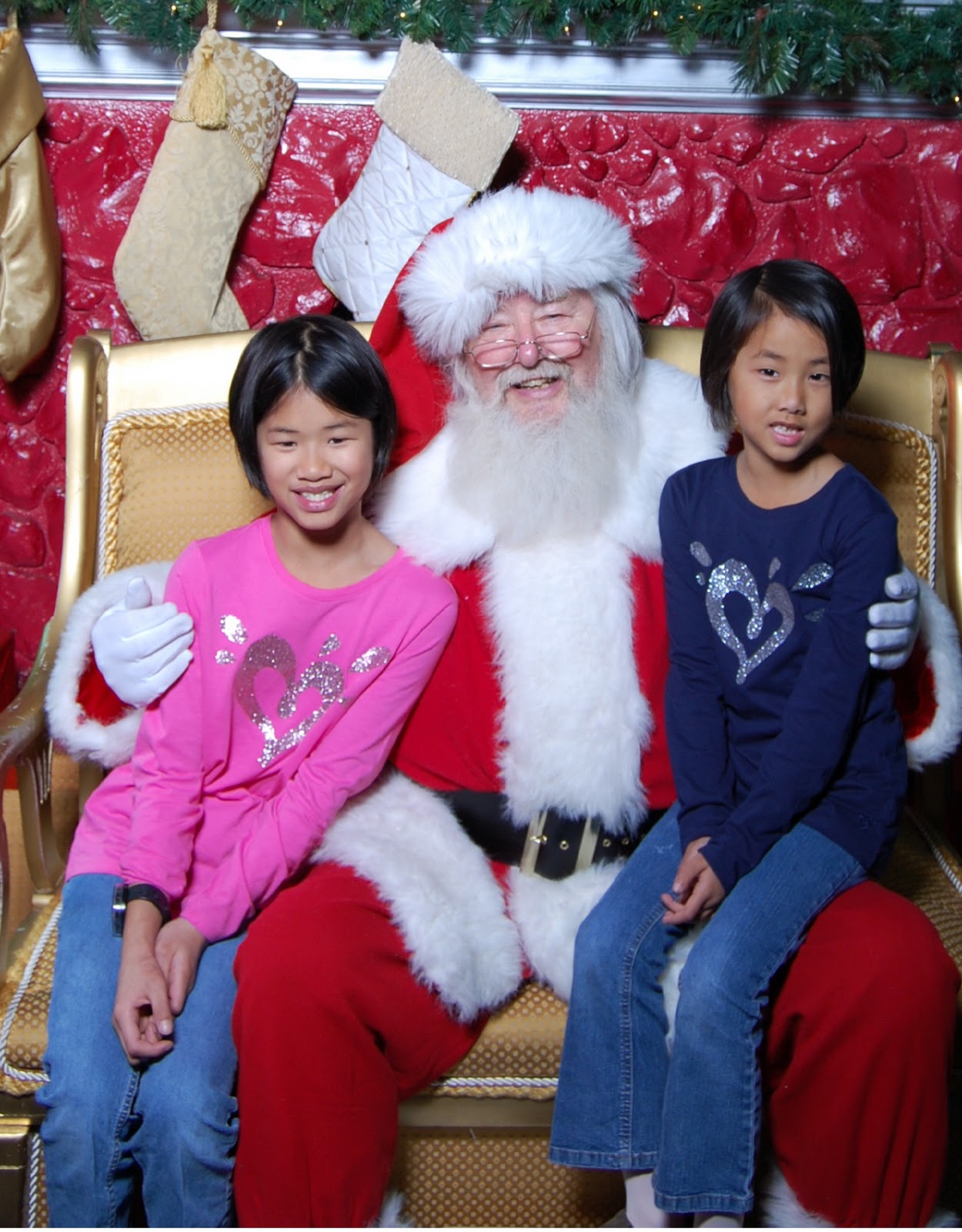
NOTHING can make me go to THE MALL (insert scary music) at this time of year. Well, almost nothing. Let Zoe break her glasses and need new ones, and suddenly we're headed to the mall (AND we get to go back to pick up the glasses, too!).
And lo! and behold, there was NO LINE at Santa's house! So this year, we have a cute Santa picture (and new purple glasses)! (I do think unplanned Santa pictures always turn out better. Not quite as much stress in getting ready and all Christmasy and all matchy-matchy (matchy-matchy was accidental this time!)).
The girls are still debating about whether this is the REAL Santa or just one of his helpers. What's your vote?
Friday, December 3, 2010
China Daily Roundup: Orphan Stories
A few interesting articles from China Daily:
China to give annual financial aid to underage orphans:

China to give annual financial aid to underage orphans:
The Chinese government said Friday it will provide annual financial assistance to underage orphans to improve their livelihood.Orphans cope after loss to AIDS:
An orphan in less developed western provinces will receive 4,320 yuan ($635) this year, a Ministry of Civil Affairs statement said.
An orphan in China's central provinces will receive 3,240 yuan while those in eastern provinces will receive 2,160 yuan.
The ministry said the nation has not supported orphans enough.
Orphanages have run short of professional nursing staff and many orphans face education, medical and employment difficulties.
This year the central government will give 2.5 billion yuan in financial assistance to underage orphans.
The money will be disbursed to orphans' personal bank accounts, those of their guardians or the corporate accounts of orphanages.
The government will continue to give financial assistance in future years, the statement said.
Touching orphans' souls with sound of music:A photo story: Children play outside their classroom in Shangcai county, Central China's Henan province on Nov 30, 2010. The children, who are healthy, have lost their parents to AIDS. But they are growing up with good care at this school, where 78 orphans study on the first floor and live on the upper one. This social welfare institution, known as China Red Ribbon Home, supported by China Red Ribbon Foundation and All-China Federation of Industry & Commerce, provides the children with primary and middle school education. [many more photos at China Daily]

After hearing the big news, the classroom erupted with screams of excitement as children ran into the halls to tell their friends: Professional musicians were coming to Beijing Angel Training School to teach them how to play the violin.Life in orphans' home in North China city:
It did not matter that most of the students had no idea what a violin is.
"When the violinist opened the case and held up the instrument, they all screamed, mouths wide open," said Zhang Mei, 59, who teaches some of the 76 orphans at the school.
On stage was Chen Qian, one of several highly trained musicians with the Wings of Music, a charity project aimed at helping disadvantaged youths gain confidence and lay solid foundations for a better future.
A 2003 nationwide study by the China Center of Adoption Affairs showed that 74 percent of abandoned and orphaned children develop behavioral problems, six times that of children with parents.
"By touching the souls of needy children through classical music, we want to drive away the inferiority and loneliness brought by the mischief of fate," said Chen, 29, who is also the project's executive director.

Photo story: Zhang Weishi watches a girl writing the Chinese character "home" in the SOS Children's Village in Tianjin municipality in North China on Nov 20, 2010. Zhang, 9, lives in the village which has been home for more than 300 orphans since its opening in 1984. The children here study nearby on weekdays and take part in some extracurricular classes during the weekend, including calligraphy, painting, Beijing opera and dance. [many more photos at China Daily]
Thursday, December 2, 2010
UN finds irregularities in Guatemalan adoptions
A brief report in the Washington Post:
Well, that's because the focus of the International Commission Against Impunity in Guatemala (CICIG) isn't adoption -- it's organized crime. From a very informative article in the Journal of International Criminal Justice, this brief explanation of the mandate of the CICIG
In investigating organized crime, which in Guatemala is linked to government actors, the CICIG came across information about adoption corruption in Guatemala. Look at what the CICIG is working on in Guatemala, according to that same article in the Journal of International Criminal Justice:
For more information about the CICIG, check out their website.
A United Nations anti-corruption commission has found irregularities in Guatemala's adoption program despite government efforts to prevent fraudulent adoptions.I was intrigued by this small blurb, because I hadn't heard that there was any U.N. commission investigating adoptions in Guatemala (and I pride myself on keeping up with these things!).
The International Commission Against Impunity in Guatemala says in a report it found cases where Guatemalan children were given to foreigners who were listed as their "foster parents" to circumvent a ban on international adoptions.
Well, that's because the focus of the International Commission Against Impunity in Guatemala (CICIG) isn't adoption -- it's organized crime. From a very informative article in the Journal of International Criminal Justice, this brief explanation of the mandate of the CICIG
CICIG’s mandate is ‘unprecedented among UN or other international efforts to promote accountability and strengthen the rule of law’15 as it is the first hybrid mechanism whose subject matter jurisdiction is not related to serious human rights violations but rather to dismantling organized crime.Let that sink in for a moment.
* * *
[I]ts mandate was tailored to address the current infiltration of government institutions by criminal clandestine organizations and the operation of violent illegal security forces outside of the control of the Guatemalan state. . . . These groups operate with almost total impunity given links to the very state actors tasked with prosecuting them.
In investigating organized crime, which in Guatemala is linked to government actors, the CICIG came across information about adoption corruption in Guatemala. Look at what the CICIG is working on in Guatemala, according to that same article in the Journal of International Criminal Justice:
As of July 2009, CICIG had been admitted as a private prosecutor in eight cases: (i) a case against the daughter of a member of the Guatemalan Congress for human trafficking and illegal adoptions; (ii) the murder of 11 people in Zacapa during a clash between drug traffickers; (iii) a case against four members of the National Civilian Police who engaged in extortion and assault; (iv) a case against Senior Prosecutor Alvaro Matus for obstructing justice and destroying evidence; (v) a case against General Enrique Ros Sosa, son of former Guatemalan General Efrain Rios Montt, and five other ex-military officials for embezzlement; (vi) a case against the kidnappers of Gladys Monterroso, wife of the Human Rights Ombudsman; (vii) a case against ex-President Alfonso Portillo for embezzlement; and (viii) an embezzlement case against ex-Defence Minister Eduardo Arevalo Lacs. In all eight cases, the accused are directly and visibly connected to government institutions, politicians or drug-trafficking organizations.Good company, eh? Organized crime in Guatemala is involved in murders, embezzlement, drug trafficking, kidnapping, and illegal adoptions.
For more information about the CICIG, check out their website.
Wednesday, December 1, 2010
Adoption Allowed for 12 Air-lifted Haitian Kids
The Washington Post reports today:
After months of uncertainty, the way has been cleared for U.S. families to adopt 12 Haitian children who've been living at a Roman Catholic institution near Pittsburgh since a chaotic airlift that followed the devastating earthquake in January.
The Haitian government had sent a letter formally approving the adoptions, State Department spokeswoman Rosemary Macray said Wednesday, and the children will be matched with U.S. families over the coming weeks.
Unlike some 1,100 other children flown out of Haiti to the U.S. after the quake, the children at the Holy Family Institute in Emsworth, Pa., were not part of the adoption process prior to the disaster and, according to some legal experts, shouldn't have been eligible for the emergency program. Most of them had birth parents still living.
However, Macray said those parents, who were interviewed by U.S. officials, have formally relinquished custody.
"Get out of my way, I'm entitled to adopt!"
I'm pretty much used to anti-UNICEF feeling in the adoption community, mostly from agencies and adoptive parents who feel that UNICEF is "anti-adoption." It's pretty popular to declare, "MY kid won't be collecting for UNICEF this Halloween." "I'd NEVER send a UNICEF Christmas card." Fine, whatever. A recent article in the Washington Times, UNICEF's Effective Attack on Inter-Country Adoption, by adoptive parent Andrea Poe setting out her grievances against UNICEF left me shaking my head and thinking, "Is that the best you've got?!":
And UNICEF says that adoption is better than orphanages -- how is that a block-adoption-at-any-cost position?
Aren't the COUNTRIES offering to send their children abroad for adoption important stakeholders in inter-country adoption whose interests should be considered? Or do you advocate ignoring their interests and simply invading and taking children to "better" adoptive homes? I think not!
And if you're not interested in reading someone else's cherry-picked assessment of that UNICEF document, read the whole thing and decide for yourself if it shows that UNICEF doesn't care about the children.
And if she thinks the Hague Convention has solved the problem of corruption in international adoption, she hasn't been paying attention. First thing on her reading list should be the article by David Smolin that I posted earlier in the week. Professor Smolin makes a compelling case, supported by evidence, that the Hague Convention has not fulfilled its promise to end corrupt practices in intercountry adoption.
That's the only damning thing in this paragraph, throwing unsupported accusations about UNICEF's motivations. Arguing that we should provide more aid for poor families is actually a good thing, I think. Keeping children with their "kinship groups" (known as "families" when we're talking about our own, but talked about in tribal terms when we talk about "the other") is a good thing. Not allowing poverty to be the thing that tears families apart is a good thing. Saying that no child should lose his or her family because of poverty is a good thing. Kids don't really care about having "the BEST homes;" they care about having their family.
You know, it's quite possible to think rich countries should aid poor countries in order to keep families together, and IN THE MEANTIME, believe international adoption is appropriate in some cases. That seems to be UNICEF's position.
Yes, UNICEF wants foster care expanded so children can be taken care of in-country, wants domestic adoption expanded, so children can be taken care of in-country. So does the Hague Convention. But it also recognizes that when that isn't possible, international adoption is appropriate. And that's what UNICEF says, too!
UNICEF's figure that there are 132 million orphans is popular to bandy about, usually by the same people who hate everything they think UNICEF stands for! But that figure defines orphans as children who have lost ONE or both parents. When you really start to dig down, you learn that only 13 million have lost both parents. And the vast majority of those 13 million children are living with the surviving parent, grandparents or extended family (you know, the same thing that would happen with our children if one parent should die.)
If you're looking at it as international adoption or orphanage, there are about 2 million children in orphanages, and not all of them are orphans. They're there because poor families need help taking care of their children. So the alternatives are not what the author here suggests -- international adoption or a slow lingering death in an orphanage.
And before blowing off better aid to poor families and expanded foster care, you might want to check out this report, Families, Not Orphanages, which argues -- with supporting evidence -- that change is possible.
If you're interested in really finding out what UNICEF's position is, instead of assuming that whatever this author wants to say is true, you might want to look at what UNICEF actually says:
UNICEF claims that international adoption robs children of their heritage and culture. The organization’s has staked out a firm position: children must be given to birth parents, regardless of the circumstance. In lieu of that, children should go to extended family. Next, to his or her “community.” Finally, domestic adoption should be explored. Inter-country adoption is “one of a range of options” according to UNCEF and should be turned to as a last resort. The organization goes so far as to claim that international adoption must be “subsidiary” to in-country adoption, at all costs.It's not just UNICEF that says that -- the subsidiarity principle has been a staple of international adoption forever, and is ensconced in the Hague Convention on Inter-Country Adoption, a document so main-stream that it's been signed by 83 nations, including the United States. If you have a problem with the domestic-adoption-before-international-adoption idea, your problem is with the Hague Convention, not with UNICEF!
UNICEF declares that inter-country adoption “is not as a good as being raised in their families of origin but better than staying in orphanages.” That would make sense if the world was a perfect place and this Polly Anna viewpoint had any basis in reality. But that’s not the world, nor is it the reality of millions of orphans around the world. Shared DNA does not make for the best families, contrary to UNICEF’s claims. Children wind up eligible for adoption for myriad reasons, ranging from poverty to abuse to neglect.Huh? What is outrageous about saying that adoption is not as good as being raised in their families of origin?! Of course it's not! The best possible thing for my daughters would have been for their birth parents to have raised them, if they had been able. That's been the "best possible thing" for the vast majority of people on this earth in the past, in the present and in the future! I was raised by my family of origin, my parents were raised by their biological parents, and their parents were raised by their biological parents, and their parents' parents were raised by their biologican parents, and so on and so on and so on. . . . And would you like to know how many of those people were raised in poverty? An awful lot! There are 13.3 million children living in poverty in the U.S. Should they all be removed from their families of origin to be raised in "stable" adoptive families? Of course not -- we mean children in poverty in OTHER countries! Well, there are 1 billion children living in poverty around the world. Should they all be placed for adoption in Western countries?
And UNICEF says that adoption is better than orphanages -- how is that a block-adoption-at-any-cost position?
In some cases, UNICEF’s positions border on racist. In a position paper on inter-country adoption the organization states, that every effort should be made to keep a child “within his ethnic group.” Huh? Some vague notion about cultural ties should trump the basic human rights of children? For what end UNICEF does not say.Actually, culture IS a basic human right of children. The U.N. Charter, the Universal Declaration of Human Rights, the International Covenant on Economic, Social, and Cultural Rights, and the Convention on the Rights of the Child all recognize this. So if you want to argue otherwise, your problem isn't with UNICEF, it's with the entire world!
There’s a disconnect between UNICEF’s position and the welfare of children. Somewhere along the way the behemoth organization lost track of advocating for children and began abstracting the issue.Oh, come now! You're being quite disingenuous here, aren't you?! YOU, Ms. Adoptive Parent, are a "stakeholder" in intercountry adoption, aren't you? Don't you want UNICEF to consider your interests?! Seems to be what this whole article is about -- YOUR interests over any other stakeholder!
You can even hear it in the language used in the organization’s Innocenti Digest entitled “Impact of International Legal Standards and the Safeguards of The Best interest of the Child in Domestic and Intercountry Adoption,” where “different stakeholders” in intercountry adoption are mentioned. Stakeholders? What about the children?
Aren't the COUNTRIES offering to send their children abroad for adoption important stakeholders in inter-country adoption whose interests should be considered? Or do you advocate ignoring their interests and simply invading and taking children to "better" adoptive homes? I think not!
And if you're not interested in reading someone else's cherry-picked assessment of that UNICEF document, read the whole thing and decide for yourself if it shows that UNICEF doesn't care about the children.
To promote its agenda, UNICEF points out that abuses have taken place with inter-country adoptions. They are right. They have. Just as they have and do with domestic adoptions, which UNICEF advocates. The Hague Convention was developed to provide guidelines for inter-country adoption with the hope of reducing abuses of the system and reducing the risk for child trafficking and profiteering from orphans. This issue so often raised by UNICEF is a canard. C’mon. Who isn’t against corruption and abuse?A canard? Abuse, including child trafficking and profiteering, is a canard? I don't think the author knows the meaning of the word canard: "a false or unfounded report or story; especially: a fabricated report; a groundless rumor or belief." She just conceded that abuses happen, so UNICEF also saying so is the OPPOSITE of a canard!
And if she thinks the Hague Convention has solved the problem of corruption in international adoption, she hasn't been paying attention. First thing on her reading list should be the article by David Smolin that I posted earlier in the week. Professor Smolin makes a compelling case, supported by evidence, that the Hague Convention has not fulfilled its promise to end corrupt practices in intercountry adoption.
What’s so disappointing about UNICEF’s position is that for years the organization has been a leader in child welfare around the world. The work that they do to help feed and immunize children is unimpeachable. And perhaps this is the problem. The organization’s success in this area has jaundiced UNICEF’s view on adoption.That's a pretty damning charge. Proof, please? If I were to say, "Adoption agencies don't really care about the welfare of the children, they just want to keep them healthy enough to be adopted so they can make a boatload of money," wouldn't you insist on proof? You certainly should. So I can demand proof when others declare, "Child welfare organizations don't want kids adopted so they can get boatloads of donations to take care of the poor orphans."
Arbitrary national borders on a map have become a greater priority to UNICEF than the complicated issues of placing children with safe, loving families wherever those families may be.You know, "arbitrary" national borders certainly seem important to us when we're trying to keep people from crossing ours; they only become unimportant when we're interested in crossing others' borders.
UNICEF has repeatedly stated that it prefers the expansion of social welfare programs for poor families within countries, so that children can stay in kinship groups. The practical outcome has been that unparented children are being denied the best homes so that UNICEF can score cheap points in the international arena about the insufficient aid poor countries receive. The pawns here are the children.Again, proof that UNICEF is trying to score cheap points and doesn't really care about children? Again, wouldn't you demand proof if I said, "Agencies and adoptive parents in the West don't want aid to families in poor countries because they want to have unfettered access to adopt children of poor people; they don't care about the plight of poor people, they just want to take their children?"
That's the only damning thing in this paragraph, throwing unsupported accusations about UNICEF's motivations. Arguing that we should provide more aid for poor families is actually a good thing, I think. Keeping children with their "kinship groups" (known as "families" when we're talking about our own, but talked about in tribal terms when we talk about "the other") is a good thing. Not allowing poverty to be the thing that tears families apart is a good thing. Saying that no child should lose his or her family because of poverty is a good thing. Kids don't really care about having "the BEST homes;" they care about having their family.
You know, it's quite possible to think rich countries should aid poor countries in order to keep families together, and IN THE MEANTIME, believe international adoption is appropriate in some cases. That seems to be UNICEF's position.
Harvard Law School’s Elizabeth Bartholet, an adoptive parent herself and a well-regarded child advocate, has publicly stated that “international adoption is under siege,” largely because of UNICEF’s unrelenting assault on inter-country adoption.Bartholet's position on international law and international human rights is not in the mainstream; it is decidedly fringe. Bartholet has even argued that baby buying is no different from surrogacy -- if we allow one, we should allow the other. After all, what's the difference between eggs carried by a surrogate and children already born to other people?!
In Batholet’s paper International Adoption: The Human Rights Position she writes, “Preferences for what UNICEF calls permanent family or foster care [in country] are dangerous. UNICEF’s argument is that such care could preserve children’s birth and national heritage links. But foster care doesn’t exist as a meaningful option in most sending countries – unparented children are instead relegated to orphanages. UNICEF wants foster care expanded, but denying children adoptive homes now because in the future foster care might exist is unfair to existing children.”
Yes, UNICEF wants foster care expanded so children can be taken care of in-country, wants domestic adoption expanded, so children can be taken care of in-country. So does the Hague Convention. But it also recognizes that when that isn't possible, international adoption is appropriate. And that's what UNICEF says, too!
The influence of UNICEF on the world community cannot be overstated. It has used its reputation as a leader in children welfare to lobby countries, including the United States, to reduce the number of inter-country adoptions. The results have had dire consequences for children around the world. International adoptions have plummeted and most countries are now closed to American parents.I think adoptive parents and agencies overstate UNICEF's influence in this area. There are way too many much more powerful actors in the international adoption arena.UNICEF is a popular bogeyman, but where's the PROOF that UNICEF has caused the reduction in international adoption? Correlation is not causation. As Professor Smolin says in his excellent article:
The current decline in intercountry adoption, and the recurrent shutdowns or slowdowns of intercountry adoption in many sending countries, are not caused primarily by pre-existing ideological opposition to moving orphans outside of their countries of origin. The primary problem is not ideological disagreement about intercountry adoption, but rather regulatory failure leading to recurrent child laundering scandals and other destructive practices. Recurrent child laundering scandals reveal intercountry adoption systems driven by a combination of profit-seeking and rich-nation demand for children. Sustaining the legitimacy of intercountry adoption under conditions of recurrent child laundering scandals is vain, as the claim to operate for the good of orphaned children is fatally undermined in systems whose “orphans” are frequently purchased or stolen children. Thus, preventing child laundering and related abuses needs to move to the center of the intercountry adoption agenda, rather than remaining a largely peripheral concern.The causes of the decline in international adoption are so clearly about corruption -- that's what's caused shutdowns in Guatemala, Vietnam, Cambodia -- and the special case of China. China was such a large actor, and I think we can all agree that UNICEF has little influence with the Chinese government! For China it is changing attitudes about girls and better economic position for many in China. That isn't UNICEF's fault, too, is it?!
The dark and highly influential shadow that UNICEF has cast on intercountry adoption has left millions of children around the world stranded, without homes and without hope.This is part of the either-or discussion of international adoption. It's either international adoption or orphanages. It's either international adoption or death. And how many "millions of children around the world stranded, without homes and hope" are we talking about, anyway?
UNICEF's figure that there are 132 million orphans is popular to bandy about, usually by the same people who hate everything they think UNICEF stands for! But that figure defines orphans as children who have lost ONE or both parents. When you really start to dig down, you learn that only 13 million have lost both parents. And the vast majority of those 13 million children are living with the surviving parent, grandparents or extended family (you know, the same thing that would happen with our children if one parent should die.)
If you're looking at it as international adoption or orphanage, there are about 2 million children in orphanages, and not all of them are orphans. They're there because poor families need help taking care of their children. So the alternatives are not what the author here suggests -- international adoption or a slow lingering death in an orphanage.
And before blowing off better aid to poor families and expanded foster care, you might want to check out this report, Families, Not Orphanages, which argues -- with supporting evidence -- that change is possible.
If you're interested in really finding out what UNICEF's position is, instead of assuming that whatever this author wants to say is true, you might want to look at what UNICEF actually says:
The Convention on the Rights of the Child, which guides UNICEF’s work, clearly states that every child has the right to grow up in a family environment, to know and be cared for by her or his own family, whenever possible. Recognising this, and the value and importance of families in children’s lives, families needing assistance to care for their children have a right to receive it. When, despite this assistance, a child’s family is unavailable, unable or unwilling to care for her/him, then appropriate and stable family-based solutions should be sought to enable the child to grow up in a loving, caring and supportive environment.So you disagree with UNICEF's position on adoption? I don't. Disagreeing with UNICEF's stated position is tantamount to saying, "Get out of my way, I'm entitled to adopt!"
Inter-country adoption is among the range of stable care options. For individual children who cannot be cared for in a family setting in their country of origin, inter-country adoption may be the best permanent solution.
UNICEF supports inter-country adoption, when pursued in conformity with the standards and principles of the 1993 Hague Convention on Protection of Children and Co-operation in Respect of Inter-country Adoptions – already ratified by more than 80 countries.
Adoption of Children & Religious Matching
One of my go-to law blogs posted about the recent news piece exploring the disjunct between Western adoption law and Islamic adoption restrictions. A commenter asked, "Could someone please clarify which U.S. law identifies an orphaned child of Muslim parents as a Muslim?" Reading the question as "why in the world is religious matching allowed," Professor Volokh gives a simple primer on religious matching and the Constitution:
I've blogged about adoption and religion issues several times, like here and here, including a critique of a former post on the subject at the Volokh Conspiracy (see here and here).
Many states have statutory provisions that provide that children be placed, when possible, in a foster home that matches the child’s religious persuasion; this also tends to cover adoption, and when a child is too young to have a religious persuasion, the law — and, I think, state child welfare agency practice — tends to follow the religious persuasion of the parents. To quote the New York rule, which is actually part of its state constitution,Feel free to post at the Volokh Conspiracy blog -- many non-lawyers do, since it is also a very popular libertarian blog.
When any court having jurisdiction over a child shall commit it or remand it to an institution or agency or place it in the custody of any person by parole, placing out, adoption or guardianship, the child shall be committed or remanded or placed, when practicable, in an institution or agency governed by persons, or in the custody of a person, of the same religious persuasion as the child.Some courts have upheld these statutes (see, e.g., here and here), and I don’t know of any court that has struck them down. The decisions aren’t generally clear on why the statutes are constitutional, but I take it that the arguments are that (1) it’s less disruptive for children who have religious practices or beliefs, (2) it makes religious parents who give up their children feel more comfortable (because they’ll believe that the children’s spiritual needs, as the parents see them, will likely be attended to), and (3) because of consideration 2, it removes one obstacle to parents’ agreeing to put their children up for adoption.
The chief constitutional objections to this, I think, are that (1) it might mean that children from some religious backgrounds have to wait longer to be adopted than children from other religious backgrounds, and (2) it requires the government to decide what religion a parent really belongs to, to decide which religions are close enough to count as being the same religion (a theological decision that the Establishment Clause generally forbids), perhaps to inquire into the adoptive parent’s level of religious observance, and do similar things. I think these constitutional objections are strong ones, but, as I mentioned, courts have not been particularly impressed by them.
Naturally, these statutes are not by any means deliberate attempts to accommodate Muslims as such. They were created to accommodate the interests of Catholics, Protestants, and to some extent Jews, but are now also being applied to other religious groups.
I've blogged about adoption and religion issues several times, like here and here, including a critique of a former post on the subject at the Volokh Conspiracy (see here and here).
Tuesday, November 30, 2010
Absurd Dilemmas Caused by Secrets in Closed Adoptions
Jean Strauss, adoptee, author (Birthright & Beneath a Tall Tree
 ) and filmmaker (Vital Records & ADOPTED: for the life of me), has this piece at the Huffington Post:
& Beneath a Tall Tree) and filmmaker (Vital Records & ADOPTED: for the life of me), has this piece at the Huffington Post:How angry would you be if the government had personal information about you -- but wouldn't let you see it? Many adult adoptees can relate to this experience -- forty states still withhold their original birth certificates from them. The secrets inherent in closed adoptions can create a lifetime of frustration and feelings of being second-class citizens -- and can also create absurd dilemmas.I've mentioned before that I'm a big Jean Strauss fan -- I had to admit that I felt starstruck when I shared a ride with her from the train station to the hotel when I attended the American Adoption Congress convention! I can't wait to see the new documentary, ADOPTED: for the life of me (I missed the screening at both the AAC convention AND the St. John's conference, darn it!). It has not yet been shown on my PBS station. Click here to see when it airs on yours.
Gay Ellen Brown is a 51-year-old Illinois adoptee who was raised in New Jersey. In 2009, she was diagnosed with several pre-cancerous breast lesions. After these were surgically removed, her doctor requested she have a BRCA DNA test to see if she carried the gene for breast and ovarian cancer. If she did carry the gene, it would guide many decisions about her future treatment and would be important for her children and grandchildren to know.
But Gay Ellen's insurance company refused to pay for the test, citing a company policy that only allowed coverage if there was a demonstrated family history of breast or ovarian cancer. Since Gay Ellen had no way of knowing her family's medical background, she could not prove the need for the genetic analysis. The BRCA test cost over $3,000, and Gay Ellen was unable to personally afford it.
"It's always in the back of my mind," she says. "Am I carrying this gene? I have three daughters and a granddaughter. What about them? The insurance company knows I'm adopted but it makes no difference."
Stupid Questions, Smartass Answers
At Parent Dish, some answers I wish I could give to stupid adoption questions:
1. Are those your real children?Yes, I know all the reasons we shouldn't answer this way -- role-modeling for our kids, people don't intend to be hurtful, etc., but it is fun to imagine!
*No, they're robots from the planet Mergatroid who landed here overnight. Careful, they may zap you with their bacteria-building laser gun.
*Is that your real brain or a loaner from the moron store?
2. Where is their real mother?
*With your husband.
*Out on parole next month. I'll give her your address.
3. Are they orphans?
*Why yes, didn't you catch their cameos in "Annie?"
4. Are your children related?
*Yes, to your father.
*Yes, they're siblings. You know, like your parents.
5. What do they eat?
*Idiots who ask stupid questions.
*Oh, goodness. Am I supposed to feed them?
7. Can we touch their hair to see what it feels like?
*Sure, for $100.
9. Did they eat monkey (kid from Africa), rice (kid from China), borscht (kid from Russia), rice and beans (Central/South America)?
*Yes, because they're walking stereotypes of [insert nationality], just like you're a walking stereotype of an American idiot.
13. Why did you adopt them?
*Because I wanted to gray faster, like you!
*Angelina was busy and Madonna couldn't take the bad publicity.
*Somebody's gotta do the household chores and it's not gonna be me.
*I'm starting a home mail-order business. Free labor!
*It was between them and a Chia pet, and all my plants end up dying.
18. Do they know who their real parents are?
*Yes, the ringmaster and the bearded lady.
*Honestly, does anyone?
*No, do you?
22. What do they call you? Mom?
*They've already adopted the American practice of, "Hey, you."
*'Mom' seems to have that motherly ring to it, which is kind of cool being that I'm their mom.
*They call me mom for the same reason people call you dumb ass. It just fits.
27. Do they speak English?
*Only when they swear.
*Yes. You should try it sometime.
30: Do they still speak (Swahili, Chinese, Spanish, Russian)?
*Only at school. It gets them special ESL accommodations. We're trying to game the system.
*That and five other languages, all fluently.
*Yes, and they're teaching me several new ways to tell you to $#@! off!
Monday, November 29, 2010
Heart and Sole
China adoptee and heart patient designs a Nike shoe:
Shelby's Nike Free Run+ 2 DB Women's Shoe has plenty of heart. That's because it comes from Shelby Lee, a 12 year old diagnosed with heart disease. After five surgeries to fix her heart, Shelby is now able to run, making this Nike Free Run+ a perfect tribute to her life story.Click here to see it!
* * *
The sockliner of Shelby's shoe features a hand-drawn map, tracing her journey from an orphanage in China to her home in Oregon. Vibrant colors pop with her inspiring drawings along the lightweight midsole, and the turquoise upper reminds her of the sky. A broken heart with the word "China" is featured on the tongue of the left shoe, and a whole heart with "U.S.A." is on the tongue of the right shoe. Shelby added this design element to show that her broken heart has been fixed.
* * *
Doernbecher Children's Hospital has been helping heal children and families in the Oregon and Washington area since 1926. It's a national leader in research and education and offers a wide range of comprehensive pediatric care. The Doernbecher Freestyle program, a partnership between Nike and Doernbecher, allows a group of special patients who have triumphed over serious illnesses to design authentic Nike shoes.
Openness in Adoption and Adoptees' Attitudes Toward Birth Mothers
You're aware of the big Minnesota/Texas adoption study, right? It's a longitudinal research study that focuses on the consequences of variations in openness in adoption arrangements for all members of the adoptive kinship network: birthmothers, adoptive parents, and adopted children, and for the relationships within these family systems. It involves a large sample, and has been following participants for over twenty years. You can read a report of the results of a wave 2 study (wave 1 was when adoptees were in early/middle childhood, wave 2 involved adoptees at average age of 15.7) here: Many Faces of Openness in Adoption: Perspectives of Adopted Adolescents and Their Parents. The study describes the different openness arrangements the adoptive families and birth mothers have, and also examines the attitudes and feelings about openness and adoption depending on the degree of openness. I was particularly interested in attitudes toward birth families. According to the study,
All adolescents were asked a general question, “How do you feel about your birth mother?”, regardless of whether they had contact. Responses about feelings toward birth mothers were coded separately for positive and negative affect, since positive and negative feelings can vary independently of each other. A 5-point scale was used, with 1 indicating no positive (or negative) affect or no feelings about her, 3 indicating moderate positive (or negative) affect, and 5 indicating strong positive (or negative) affect. Value 2 fell between 1 and 3, and value 4 fell between 3 and 5. Examples of positive affect included descriptions of adolescents’ feelings about their birth mother that used words such as love, happiness, excitement, interest, pride; examples of negative affect included words such as sadness, nervousness, anxiety, shame, anger.According to the researchers, "Adopted adolescents’ positive feelings about their birth mothers varied significantly as a function of openness arrangements. . . . [T]he mean level of positive affect was significantly higher in the contact with meetings group than in the no contact or stopped contact groups. . . . Negative feelings about birth mothers did not vary as a function of openness arrangement." Furthermore,
Adolescents having contact with meetings were asked how they felt after the meetings. Each adolescent’s interview response was coded for the predominant three descriptors. . . . Half of the responses were accounted for by two categories: “pleasure/happiness/contentment” and “anxious/apprehensive/concerned/nervous/tense/weird.” None of the adolescents reported feelings of fear, hatred, surprise, anger, or confusion about who their parents were. Twenty-seven adolescents (51.9 percent) reported a mixture of descriptors that seemed to include both positive and negative feelings after meetings. A typical combination was “nervous” and “very happy.” A total of 21 adolescents (40.4 percent) reported only positive feelings, 2 (3.8 percent) reported only negative feelings, and 2 (3.8 percent) said they did not remember how they felt. The latter two adolescents said they had only met their birth mother once.The researchers conclude:
These data revealed that many adolescents’ meetings with birth relatives are an occasion for a mixture of feelings, especially pleasure intermingled with nervousness. However, it is especially noteworthy that no adolescents mentioned that meetings made them feel afraid, surprised, angry, or confused about who their parents were. This should be reassuring to prospective adoptive parents who mention concern about confusion as a reason for not having birth parent contact. Once again, we have found no evidence that contact is inherently harmful to children’s or adolescents’ well-being.Reassuring, indeed.
Intercountry Adoption, Child Laundering & the Hague
At the St. John's adoption conference I attended in October, Professor of Law David Smolin was one of the keynote speakers. He talked about corruption in international adoption, asking a very important question -- is the problem one of a few bad actors or is there something systemic wrong with international adoption?
He concluded that the problem was systemic, that international adoptions went wrong even when well-intentioned, honest and reputable agencies sought to do ethical international adoptions. The problem, he said, was money. What the West sees as small amounts of money -- paid to birth parents, foreign "facilitators," orphanage directors, government officials -- are huge amounts of money in most sending countries. With rich-nation demand for children and profit-seeking motives in sending countries, international adoption as currently practiced leads to child laundering, which "involves obtaining children illicitly through force, fraud, or financial inducement; providing false paperwork which identifies such illicitly obtained children as legally abandoned or relinquished 'orphans'; and offering or placing these socalled 'orphans' for adoption."
In this important law review article, CHILD LAUNDERING AND THE HAGUE CONVENTION ON INTERCOUNTRY ADOPTION: THE FUTURE AND PAST OF INTERCOUNTRY ADOPTION, Professor Smolin considers whether the Hague Convention can lead to needed reforms in international adoption. He provides very interesting information about the negotiations leading up to the passage of the treaty; noting that the treaty negotiations happened against the backdrop of a report about adoption corruption by Hans Van Loon, Smolin says the U.S. position seemed less concerned about corruption:
Professor Smolin suggests to following reforms to allow the Hague Convention to fulfill its promise of ethical international adoption free from corruption:
FYI, Professor Smolin in an adoptive parent. You can read part of his story here.
He concluded that the problem was systemic, that international adoptions went wrong even when well-intentioned, honest and reputable agencies sought to do ethical international adoptions. The problem, he said, was money. What the West sees as small amounts of money -- paid to birth parents, foreign "facilitators," orphanage directors, government officials -- are huge amounts of money in most sending countries. With rich-nation demand for children and profit-seeking motives in sending countries, international adoption as currently practiced leads to child laundering, which "involves obtaining children illicitly through force, fraud, or financial inducement; providing false paperwork which identifies such illicitly obtained children as legally abandoned or relinquished 'orphans'; and offering or placing these socalled 'orphans' for adoption."
In this important law review article, CHILD LAUNDERING AND THE HAGUE CONVENTION ON INTERCOUNTRY ADOPTION: THE FUTURE AND PAST OF INTERCOUNTRY ADOPTION, Professor Smolin considers whether the Hague Convention can lead to needed reforms in international adoption. He provides very interesting information about the negotiations leading up to the passage of the treaty; noting that the treaty negotiations happened against the backdrop of a report about adoption corruption by Hans Van Loon, Smolin says the U.S. position seemed less concerned about corruption:
The goals of the United States during the negotiations appeared somewhat distinct from that of Mr. van Loon. Thus, while Peter Pfund, the head delegate for the United States, acknowledged that the Hague Convention was created in the shadow of reports about child trafficking in the intercountry adoption system, these anti-trafficking concerns apparently were far less central to Mr. Pfund and the United States than they had been to Hans van Loon and other nations. Indeed, it seems likely that the United States was focused, as a receiving nation, on maintaining access to children for intercountry adoption, and on protecting the role of private agencies and individuals as independent participants in intercountry adoption.The Hague Convention that resulted, then, had child laundering as a central concern, but approached it indirectly by leaving it to each country to implement enforcement through its Central Authority (the State Department for the U.S.). It is not surprising, then, that Smolin concludes, "Seventeen years after the creation of the Hague Convention, the Convention thus far has failed to meet its goals." He believes it is too early to declare the convention a complete failure, though, because the U.S., one of the largest players in international adoption, has only been a part of the Hague Convention for a very short time.
Professor Smolin suggests to following reforms to allow the Hague Convention to fulfill its promise of ethical international adoption free from corruption:
(1) Strict limitations on fees and donations related to intercountry adoption must be created and vigorously enforced by both sending and receiving countries. All financial aspects of intercountry adoption must be both limited and made fully transparent.This is an important article, and I recommend that you read it in its entirety. There's a great compilation of corruption scandals affecting nation after nation after nation, consideration of the lessons to be learned from these scandals, helpful historical background on the Hague Convention, and analysis of whether recent declines in international adoption can be blamed on the Hague Convention (Smolin concludes not).
(2) Receiving nations must recognize that they cannot simply outsource their own responsibilities for intercountry adoption to sending nations, due to limited government capacities, lack of political will, and corruption issues in many sending countries. Thus, receiving nations must be willing to seriously investigate the critical steps occurring in sending countries, including especially the processes by which children are obtained and labeled as eligible for intercountry adoption.
* * *
(3) Specific cases of child laundering and child trafficking in the intercountry adoption system must be investigated in a manner analogous to an airplane crash. Such situations are tragic, but create opportunities to learn what has gone wrong, and what can be done to avert future disasters. The current tendency to
essentially privatize such wrongdoing as simply a problem for adoption triad members, without significant government investigation and involvement, must end.
(4) Hague receiving countries, including particularly the United States, must apply equally vigorous regulatory and investigative approaches to adoptions from both Hague and non-Hague countries. While intercountry adoptions from non-Hague countries may still be permissible, receiving countries should be equally vigilant with regard to all intercountry adoptions. Otherwise, even if the Convention eventually proves effective, a two-tier system will develop in which agencies are constantly opening up adoptions in non-Hague countries in order to escape increased safeguards. The current approach by the United States of only applying increased regulatory safeguards to adoptions from Hague countries seems nonsensical and should be discontinued.
FYI, Professor Smolin in an adoptive parent. You can read part of his story here.
Sunday, November 28, 2010
Reconciling Islamic Kafalah & Western Adoption
Interesting article -- yes, the lead-off sounds like an adoption agency trolling for clients, but the issue is more complex than that -- about U.S. Muslims wanting to adopt but not wanting to violate Islamic law that prohibits Western-style adoption:
Helene Lauffer knew Muslim children — orphaned, displaced, neglected — needed homes in the United States. She knew American Muslim families wanted to take them in.
But Lauffer, associate executive director of Spence-Chapin, one of the oldest adoption agencies in the country, couldn't bring them together.
The problem was a gap between Western and Islamic law. Traditional, closed adoption violates Islamic jurisprudence, which stresses the importance of lineage. Instead, Islam has a guardianship system called kafalah that resembles foster care, yet has no exact counterpart in Western law.
* * *
However, Islamic scholars say the restrictions were actually meant to protect children, by ending abuses in pre-Islamic Arabic tribal society.
Ingrid Mattson, professor of Islamic studies at Hartford Seminary in Connecticut, said adoption in that period had more in common with slavery. Men would take in boys, then erase any tie between the child and his biological family. The goal was to gather as many fighters as possible as protection for the tribe. Orphans' property was often stolen in the process.
As a result, Muslims were barred from treating adopted and biological children as identical in naming or inheritance, unless the adoptee was breast-fed as a baby by the adoptive mother, creating a familial bond recognized under Islamic law.
* * *
Open adoption, which keeps contact between the adoptee and his biological family, is seen as one potential answer. In New South Wales, Australia, child welfare officials created an outreach program to Muslims emphasizing that Australian adoptions are open and adopted children can retain their birth names. The New South Wales program is the only well-known adoption campaign targeting a Muslim minority population in a Western country.
* * *
Catherine England, a Muslim who teaches in the Seattle area, adopted four children after she and her husband learned they could have no children of their own. One of her children is an orphan from Afghanistan. Two others are biological siblings.
"I felt that my understanding — and this is entirely my understanding — is that what is forbidden in Islam is closed adoption," said England, who converted to Islam more than three decades ago. She consulted a Muslim scholar who she said affirmed her view that open adoption was allowed.
Saturday, November 27, 2010
Open adoption makes lifesaving difference
From nola.com, another story of a bone-marrow transplant needed by an adoptee, a mixed-race adoptee who would have difficulty finding a non-related donor -- this one happily a better ending than most because an open adoption made access to biologically related donors possible:
Jeff and Roxanne Tully have something special to be thankful for on this Thanksgiving holiday: the chance for their daughter Madison to have a long, healthy life.I've blogged before about adoptees and transplants here.
“We’re thankful that God sent us a cure,” Roxanne said.
That cure came from Madison’s biological sister, Jasmin Thomas, 18, of Metairie, who donated her bone marrow to Madison in August.
“Jasmin is a special love of our family,” Jeff said.
This story begins in the summer of 1994, three months after the Tullys were accepted into the Volunteers of America adoption program. The adoption coordinator called to tell them a young pregnant woman had looked at their questionnaire and wanted to meet them. It was an open adoption program, where the birth mother chooses the adoptive parents. The baby’s birth mother chose them, and they brought Madison home to Destrehan that July.
I wrote about the Tullys and their beautiful baby daughter when Madison was 9 weeks old. Jeff and Roxanne wanted to share their joy with the world and let people know about open adoption.
“Everyone keeps saying what a lucky little girl Madison is, but we’re the ones who are blessed,” Jeff said the day I first met them.
At that time, they had no idea what a blessing the open adoption would be 16 years later, when it would make a lifesaving difference for their family.
Friday, November 26, 2010
NYT: Betty Jean Lifton, Adoption Reformer, RIP
Betty Jean Lifton's death is finally noted in the New York Times:
Betty Jean Lifton, a writer, adoptee and adoption-reform advocate whose books — searing condemnations of the secrecy that traditionally shrouded adoption — became touchstones for adoptees throughout the world, died on Nov. 19 in Boston. She was 84 and lived in Cambridge, Mass.
* * *
Ms. Lifton, who lectured widely about the potential psychological effects of adoption, was best known for a nonfiction trilogy: “Twice Born: Memoirs of an Adopted Daughter” (McGraw Hill, 1975), in which she recounts her adulthood search for her birth mother; “Lost and Found: The Adoption Experience
” (Dial, 1979); and “Journey of the Adopted Self: A Quest for Wholeness
” (Basic Books, 1994).
* * *
When “Twice Born” was first published, there were few books about the adoptee experience. Adoption in general was a veiled topic, and adoptees — assuming they were told anything — rarely knew their given names, their birth parents’ identities or the precise circumstances of their adoptions.
As a result, generations of adoptees grew up with a void where their personal histories should be and, Ms. Lifton argued, with deep feelings of confusion, grief and loss.
“When I was born, society prophesied that I would bring disgrace to my mother, kill her reputation, destroy her chances for a good bourgeois life,” she wrote in “Twice Born.”
She added: “I say that society, by sealing birth records, by cutting adoptees off from their biological past, by keeping secrets from them, has made them into a separate breed, unreal even to themselves.”
* * *
She dedicated “Journey of the Adopted Self” to her two mothers, who, she wrote, “might have known and even liked each other in another life and another adoption system.”
Thursday, November 25, 2010
A Thanksgiving Funny
Maya learned a new Thanksgiving fact at school last week and was very excited to share it with us -- the Pilgrims had popcorn at the first Thanksgiving.
Zoe, with complete big sister superiority, told her, "That can't be right, Maya. They didn't have microwaves back then!"

Zoe, with complete big sister superiority, told her, "That can't be right, Maya. They didn't have microwaves back then!"

I Am Thankful, Reader Edition

It's our first Thanksgiving without Grandpa, but we're OK, spending the day at my brother's house, with family and good food. As Grandpa would have said, "I feel sorry for anyone who isn't me today!"
Happy Thanksgiving to you all!
The Faculty Lounge Talks Adoption Tax Credits
The Faculty Lounge is a law professor website that usually focuses on law school issues, but also talks general law at times. A new post talks about the different treatment of domestic and international adoption for purposes of the adoption tax credit:
Over-simply stated, a tax credit is available for expenses related to an international adoption only if the adoption becomes final, but the same finality rule does not apply to expenses for a U.S. adoption.What do you think? Is the disparate tax treatment justified? If you go to China to adopt, and while there the adoption falls through -- the child has unexpected issues the family felt it could not handle, or the child has died and the government offers a substitute referral the family isn't prepared to accept -- should the expenses be deductible? If not, how is this different from a domestic adoption that falls through in the U.S.?
What might be the policy reasons for this tax discrimination? Is it because significant tax revenue is at stake? According to U.S. State Department figures, the number of international adoptions has increased steadily. In 1999, there were 167,369. [gotta be a typo] In 2000, there were 18,477. In 2001, there were 19,237. If there were a correlation between completed adoptions and failed adoptions, one could make a rough estimate of the number of taxpayers who could have benefitted from an adoption tax credit, but for the fact they could not or did not finalize their international adoption.
Alternately, is the different tax treatment of U.S. and international adoptions just one more example of attempts to influence social policy through the tax laws? Maybe, but I wonder whether tax credits factor significantly into a decision to adopt a U.S. citizen versus a non-U.S. citizen.
Wednesday, November 24, 2010
"No better women than our Chinese girls"
I found this China Daily article, about some Chinese men preferring to marry Western women, interesting:
"Chinese man fancies Western woman" was the title of the personal ad Li Lei posted online, in which he asked if any Western "ladies (in Beijing) are open to a long-term and serious relationship with a Chinese guy". And by "long-term and serious", Li meant marriage.But even more interesting and amusing and sometimes disturbing are the reader comments to the article:
Marriages between Chinese men and Western women in China are noticeably fewer than vice versa, so why is Li taking the road less traveled?
After studying for a combined five years in the Netherlands and United Kingdom, the 30-year-old Beijinger discovered he preferred the personality of Western European women. He considers them more independent than their Chinese counterparts, less girlish and more straightforward.
Li puts extra emphasis on the last attribute.
"That's something I really love. If they want something, they just tell you," he says in British-accented English, his boyish face lighting up. "Although it is the nature of a woman to want somebody to figure them out, the key factor is the degree."
How can a Chinese man with a mind of his own live together with a Western woman whom is reputed to be very outward too? The like poles of a magnet will oppose when the ends are placed close together. The unlike poles will attract. Human relations are like magnets. If one is hard, the other should be soft, then living together is possible. Of course having the same interest is quite another thing to compatibility.
* * *
With China's one child policy, little emperors are more than little empresses. Perhaps because of this, Chinese men may have to seek foreign brides. However, in my mind there are no better women than our own Chinese girls. One would not need to worry too much about lifestyle changes, adjustments to accommodate foreign spouses and of course, having to tolerate the culture differences.
* * *
We can learn foreign cultures but not invite foreign culture into our lives unnecessarily. I look at the kids of mixed marriages. What will become of them when they do not look Chinese nor American (as the children in this article showed). Looks may not be important but will they call themselves Chinese and be proud Chinese. Because the mother is American, it is most likely these Children are inclined to think Americanism than Chinese. It would be okay if both the Chinese father and the American mother make it a point to raise these beautiful kids to be very Chinese. But judging from the English names, I do not see this happening in this family.
* * *
I am a happily married person (of course with a Chinese wife). If there is reincarnation and I have a second chance I would still look for a Chinese wife. Luckily mixed marriage between Chinese man and foreign ladies are few in between. No I am not racist nor anti mixed marriages but I would prefer a distinct and identifiable Chinese race.
* * *
China is for the Chinese. Foreign wives must be willing to be integrated into being Chinese.
Tuesday, November 23, 2010
It's a wild ride -- the truth about adoption
From Parenting.com, a refreshingly frank article about adoption, and in particular adoption from foster care:
National Adoption Month is coming to a close. Each year, groups across the nation hope to find a way to encourage the adoption of the estimated 115,000 children in foster care. Those of us who have opened our hearts and homes to a foster child want to be encouraging as well.How about that? An article for National Adoption Month that goes beyond the rah-rah cheerleading we're used to. I can't help but think this approach wil be MUCH BETTER for adopted kids in the long run, since adoptive parents without adequate preparation who think it will all be rainbows and unicorns are NOT what hurting kids need.
At any given moment, you feel as though you are on a roller coaster of emotions experiencing the wildest ride in your life. Moments of joy are often punctuated by longer dark moments of frustration. We hold onto the bright moments hoping they won’t disappear and cling to our support group in the dark times.
The challenge is that most adoptive parents want to cover up all the pain a foster child has felt with a big hug and cookies. Some adoptive parents travel down the road of adopting a foster child because they want a child who will love them. A few believe if you change the child’s environment, clothing, and diet, he or she will be fine. If you believe these statements are true, you should think twice about adopting a foster child.
The truth is that when you adopt a foster child, especially an older one, it’s a very long road to healing – one that may never develop into the picture we often see of smiling faces on the families portrayed in the ads for National Adoption Month.
Estate Planning & the Adoptive Family
This article in Forbes focuses on some issues adoptive families need to think about when estate planning; yes, once a child is legally adopted, they are treated the same as biological children for inheritance purposes. But what about the period before the adoption is final? What about picking guardians who share your values about adoption, culture-keeping, openness? Some good points here:
An adopted child only has rights to your estate once the adoption has been finalized. The length of time it takes to finalize an adoption depends on where the adoption was initiated as well as a host of other factors. This process can take anywhere from six months to several years to complete. In the event that you pass away before this process is complete, it is likely the child would not be entitled to any of your assets.
* * *
Caring for an adopted child may require you to put some extra thought into a number of provisions. If, for example, you adopted a child from another country and wish to expose the child to his home culture, your Will and Trust should reflect these desires.
When designating a guardian, it is important that he understand your family’s unique circumstances. You will want to choose a person who knows the details of your family’s adoption and is willing to maintain the lifestyle that you have chosen for your adopted child. It may be a good idea to provide the designated guardian with documentation that contains the details of your child’s adoption. Particularly in the case of an open adoption, it is important to establish a good relationship with the individuals outside your immediate family, such as the child’s birth parents, who will have a direct interest in your child’s life. In choosing a guardian, you will want to choose a person who is willing to maintain those ties.
Monday, November 22, 2010
Kids of 'Quiet Migration' Come of Age
Interesting story of adult and children international adoptees, issues surrounding adoption loss, and search and reunion with birth parents:
As Jenna grew up she would learn that she had been given up for adoption in Seoul at the age of three.It's hard to do justice to the article with a short excerpt. It profiles Jenna, who searches and finds birth family in Korea; Kim, who isn't interested in returning to Korea, but who left racial isolation in New Zealand for more diversity in Vancouver; Anna, adoptive mom who facilitates birth parent searches abroad; 9-year-old twins adopted from Romania, Mikaela and Zoe, who reunited with their birth mom last summer. Go read the whole thing!
What she didn't know was why.
Jenna, now 28, is one of thousands of inter-country adoptees in Canada, part of a global demographic that has been called the "quiet migration."
Between 1971 and 2001 in the United States, more than 265,000 children were adopted from abroad; in Canada, numbers have hovered around 20,000 per decade since the 1980s.
It is a demographic that is coming of age.
Many of these children, like Jenna, face unique issues of racial and cultural identity, and belonging. For inter-country adoptees, searching for resolution by finding a birth parent is daunting, if not impossible.
Lee Crawford, an art therapist and registered clinical counsellor, sees many adoptive families in her practice.
"Many of the psychological and emotional issues are the same for domestic and international adoptees: the loss of the biological family system," Crawford said. "But with international adoption we have an additional loss, of culture and country."
Even a child adopted at birth can grow up grieving for a country she has never known.
Sunday, November 21, 2010
Helping Your Child Share Feelings
Came across this post today:
There are many reasons why children have limited emotional skills: a parent may think the child is too young to learn emotional language, the child may not like to share feelings or the parents themselves may not be gifted in this area. No matter the cause, you and your child can learn the steps to improve emotional expression. They are:Good advice, and a great precursor to adoption talk. This is part of the vocabulary kids need to understand and process adoption.
1.Teach her the primary feeling words: happy, sad, mad, scared. Write each feeling word on a piece of paper; for elementary age and younger, draw or paste a feeling face picture to the corresponding feeling word. Post the paper in an eye-catching spot in your home.
2.Help him learn which facial expression matches each feeling word. For example, on your face show him a smile and raised eyebrows to display happy feelings whereas a furrowed brow and tight mouth display mad feelings. Make it a game; take turns showing a feeling face. Allow the other person to guess which feeling face was demonstrated. To keep your child’s attention, keep score and award a small prize or treat to the winner.
3.Encourage your child to express her feelings. Include verbal and nonverbal forms of communication. Some nonverbal ways to share feelings include writing, painting or drawing. Many families have a special alone time to talk about feelings. In the beginning ask your child to complete a sentence, such as: Today I feel happy/sad/mad/scared because . . .
4.Ask your child to communicate his feelings in the moment. When you notice your child experiencing feelings ask, “How are you feeling?” If he is unsure point it out to him, ie: “I see your big smile, are you happy?”
5.Give positive reinforcement for sharing. Even if your child isn’t accurate at first, recognize his attempts with praise. Remember, just like any new skill, time and practice improves performance.
Saturday, November 20, 2010
Culture-Keeping: We're not alone
I was reminded the other day that those of us who have adopted from abroad are not alone in our worries about keeping our kids connected to their heritage. I was talking to the father of one of Zoe's schoolmates. The family is originally from Mexico -- dad, second generation and kids, therefore, third generation. He was telling me that the reason his kids were attending Catholic school had more to do with culture-keeping than religion. He bemoaned the fact that the family rarely visited Mexico, that his kids did not speak Spanish. He said, "They've lost so much of their culture that I figured we could at least give them the religion of their heritage."
Interesting, hmm?
Interesting, hmm?
Friday, November 19, 2010
Sheryl Crow Rejects Open Adoption
According to this gossip site, Sheryl Crow requested closed adoptions:
Sheryl Crow asked officials to keep the details of her adoption bids secret - because she didn't want her sons' biological mothers to see their kids in the press.That's a new reason for rejecting open adoption; what do you think?
The All I Wanna Do hitmaker decided to adopt a child following the breakdown of her relationship with cyclist Lance Armstrong in 2006, and she welcomed little Wyatt into her life a year later (07). She went on to adopt a second son, Levi James, earlier this year (10).
And the star had one demand for adoption officials when they were filing her request for a child - she wanted her case to be closed to the public to save the boys' real parents any more heartache.
She tells the Guardian, "I said I would take whichever baby I was supposed to have. My philosophy was that souls find each other; you don't end up with the wrong child.
"(But I wanted a closed case). It would be extremely hard for a mother to watch the child she gave away... grow up in the magazines."
Thursday, November 18, 2010
Adoption as a Second Language
A roundtable discussion about adoption language with three writers who are also a birth mother, an adoptee and an adoptive parent, introduced as follows:
As writers, we have an intimate relationship with words; we feel their weight and recognize their significance on a daily basis. For those of us touched by adoption, this relationship becomes even more complex. Often, joining the adoption community means learning a new language; figuratively – as old words take on new meanings and others become suddenly insufficient, and literally – when adoption brings a foreign language to the family.
Vocabulary, phrasing, and naming become delicate matters that often require not only great sensitivity, but an abundance of creativity as well. We work together, within our own families, and inside the greater community, using words to educate and support one another. Communication is essential for adoption relationships to thrive, and while there are numerous tools at our disposal, words can be both the greatest and weakest of these.
I asked three fabulous She Writers to share some thoughts and memories from their own experiences with adoption. I picked and probed into some very personal issues, and all three women were generous in both their willingness to share, and the honesty with which they did so.
Wednesday, November 17, 2010
As your adopted kids grow older . . .
A wonderful, terrific, important, helpful, must-read post from Christine at Welcome to my Brain, on something that adoptive parents learn as their children get older:
My children who joined our family through adoption are now 7, 11 and 14.So what has changed for you as your adopted children have left toddlerhood and reached school age, middle-school age, high-school age? Have you been surprised by their attitudes toward adoption, birth family, birth culture? If you have more than one adopted child, are their reactions and feelings different when it comes to adoption issues? Go read what Christine has to say, comment there, and come back and start/join the discussion here!
And as they grow, things are different.
My entire perspective has changed as I acknowledge and honor their individual needs. One of them may love talking about adoption one day and despise it the next. One may crave the contact we have with their first family and extended family, while another may want nothing to do with it (pick any random day and that changes again). One may talk about their home country with pride, while another is indifferent. Of course, none of these reactions mean they don't care. If anything, it means they have massive feelings for their history ... their family. It is beyond important to them.
* * *
So, I have had to wake up to a few things that were never even on my radar just a few years ago. For instance, I have one child whose stomach is turned by the word "orphan" or "orphanage." With good reason. Regardless of the status of this child's first parents, the word "orphan" sounds hopeless and awful and wrought with pain. It has been placed on them in the past, and continues to be connected to their people and their country. This child hates it. "Orphan Sunday?" Yeah. Not a positive thing for them. at. all. They see it as churches being cruel and calling children a name that is negative.
* * *
I am learning to give them space and have zero expectations on their feelings from minute to minute. It is theirs. I am not them. I have no right to tell them what to feel, how to feel it or when to feel differently.
Tuesday, November 16, 2010
Film Review: Little Sister
We can't wait to see this Chinese version of the Cinderella tale, Little Sister! Variety gives it a prettty strong review:
I hope Variety is right about strong commercial prospects for this film -- I'm hoping for a distribution deal that will bring it to Fort Worth SOON!
A strikingly lensed fairy tale as magical as its picturesque design, "Little Sister" is the rare pic practically guaranteed to enchant tots and parents alike. Novice helmer Richard Bowen's [husband of Jenny Bowen of the China orphan charity Half the Sky; and you might know Bowen from the photography book Mei MeiThe reviewer obviously doesn't like the narration, but the fact that the film is narrated by Brenda Song is one of the attractions for my kids. In case you've missed her, she's the infamously dim and self-centered London Tipton in Disney's Suite Life franchise, and she's Asian-American. My kids are big fans (somewhat to my dismay! Some days I feel that if I hear another "Londonism" from one of them, I'll lose it . . . .)., of children in China orphanages] previous career as d.p. on largely middling pics from the late '80s through the '90s can now be safely archived, judging by this richly told girl-power fantasy based on a classical Chinese "Cinderella" incarnation. If only Bowen had ditched the gratingly jejune English narration, all would be near-perfect. Still, what's onscreen is more than good enough for strong commercial prospects in both this multi-lingo format and a planned all-English dubbed version.
Most Western auds are unlikely to grasp initially that the pic's helmer is American, as Sinophile Bowen and his Chinese colleagues have taken enormous care to ensure a level of authenticity (shooting was largely done in Yunnan province) while allowing for plenty of fantasy elements to capture the imagination in exquisite ways. Co-producer Barbie Tung is a longtime key collaborator on Jackie Chan pics, and d.p. Wang Yu builds on the talent he displayed in such features as "Suzhou River" and "The Go Master."
The story is taken from the early Cinderella tale "Ye Xian," written in 768 A.D.; viewers' acquaintance with key elements, combined with unfamiliar twists, means "Little Sister" weds the comfort of the recognizable with the delights of the unexpected.
* * *
Aside from its sheer entertainment value, the pic pushes a strong feminist element that's especially timely given recent reports [recent reports? what recent reports?] on female infanticide in China. The moral, that a proper balance allows us to become fulfilled, is easily embraceable by all cultures, furthering the likelihood that this child-friendly film is poised to conquer multiple territories. Whether kids will find the narration as infantilizing as many adults will is difficult to gauge; it's not just the words used but the irritating tone of wonderment in which they're delivered, despite narrator Brenda Song's honeyed voice.
I hope Variety is right about strong commercial prospects for this film -- I'm hoping for a distribution deal that will bring it to Fort Worth SOON!
Seoul Searching
An adoption article in an unusual venue, the Meetings Professionals International website:A trip to
Seoul changed Libby and David Gluck forever. The couple had planned the visit for years. They studied pictures, daydreamed and filled out enough paperwork to choke a super-sized recycling bin. But when you ask Libby what tourist sites she most looked forward to visiting, she admits she didn’t give it much thought.Thanks to KAAN: the Korean American Adoptee Adoptive Family Network facebook page for the link.
Her lack of specificity can be forgiven. The 30-something couple didn’t visit Seoul as tourists—they went to pick up their adopted daughter.
Baby Georgina certainly isn’t the first infant adoptee to leave Indochina for a new home.
Prior to the trip, Libby—herself an adoptee—barely had time to think about diapers, formula and car seats, let alone Seoul’s sights. But after reflecting for a few moments, Libby recalled that she and her husband planned to spend time exploring Seoul’s neighborhoods, finding off-the-beaten-path restaurants that serve home-style soon tubu jjigae (tofu soup) and visiting some of Seoul’s famous flea markets.
In August, 800 members of the International Korean Adoptee Associations (IKAA) visited Seoul. The conference was a cultural exchange of sorts, with Korean adoptees from Australia, Europe, North America and Scandinavia meeting to share experiences, network with Korean nationals and make professional connections.
* * *
Dr. Kim Park-Nelson, a professor of multicultural studies at Minnesota State University and herself an adoptee, headed a symposium at the conference where the cultural, social, historical and political implications of Korean adoption were discussed. Park-Nelson says that conferences such as IKAA are important to the adoptee community, because as the number of transnational adoptions grows, more people struggle to find their identities.
“With adoption there’s always the question, ‘Who are you? Are you American or are you Korean? Are you white or are you Asian?’” Park-Nelson said.
For many IKAA conference attendees, visiting Seoul was a step toward discovering the answers.
* * *
The Glucks traveled to Seoul in late October, at the height of the fall foliage and mild weather, to pick up Georgina. They were able to extend their trip and explore the sights, sounds and smells of Seoul. The self-described foodies navigated their way around town and found specialty restaurants, unique neighborhoods and some locals who saw the Glucks as an opportunity to practice English.
Libby reflected on the trip upon her return. She was keenly aware that during her stay she was Korean and American, Asian and Caucasian, adoptee and adopter and, now, daughter and mom.
“It was very full circle that I traveled to Korea to pick up the baby,” she said. “I knew the emotions were going to flood in when we set foot in Korea. I felt like I was on a nice vacation but with a huge added bonus.”
She felt like an old soul in Seoul—just like her 800 counterparts at the IKAA conference.
Monday, November 15, 2010
10 Common Misconceptions About Adoption
Shannon, transracial adoptive mom who blogs at Peter's Cross Station, has a great post for National Adoption Awareness Month at BlogHer, 10 Common Misconceptions about Adoption. I'm only giving her ten headings here -- go to to the article to read what she has to say debunking each one.
1. Birth mothers are all teenagers.Sometimes I feel that debunking these myths is a full-time job! How many have you encountered? How do you clear up the misconceptions? If you haven't had to yet, Shannon gives you great ammunition for doing so.
2. Open adoption is confusing to kids.
3. They hate girls in China.
4. Black babies are the latest trend among celebrities.
5. Adoptive parents are saintly for adopting.
6. Adopted kids are lucky.
7. Adoption costs a lot of money and only rich people can afford it.
8. There is a high level of risk that once adopted, a child will be given back to/taken back by biological family members.
9. Birth mothers are saintly for placing their children in adoption. OR Birth mothers are demons for getting pregnant unintentionally/being “unfit”/not loving their children enough to raise them.
10. Adoption is the opposite of abortion. As long as we have one, we don’t need the other.
Subscribe to:
Posts (Atom)


